


Bitcoin Price Prediction 2026-2030: Facts, Sentiment and Concerns
Bitcoin price prediction is no easy feat. In just four months, BTC dropped 52% without any major disruptions to trigger the fall. This article is a collective attempt to predict the unpredictable, explore what’s driving market sentiment, the arguments from both bulls and bears, and the factors that would need to align for either side to win.

Bitcoin hit $126,000 in October 2025. By February 6, 2026, it was at $60,000. That's a 52% drop in four months. The wild part: no crypto exchange collapsed, no protocol broke. The crash was driven by a tech stock sell-off, leveraged position unwinds, and ETF outflows.
VanEck, a renowned global investment management firm, called it "orderly deleveraging rather than capitulation." Which is analysts’ euphemism for “everyone left the building in an organized panic.”
Since then, BTC has been hovering - for over two months now $76,000 has acted as a ceiling.
So, where does Bitcoin go from here: through 2026, 2027, 2028, all the way to 2030?
We’re not going to give you a bitcoin future price prediction in the traditional sense. We don't know where BTC will be in 2030. And nobody does.
The only Bitcoin price prediction that always comes true is this:
 Source: r/Bitcoin
In this article, we’re mapping the sentiment: what the market believes right now, what arguments the bulls and bears are actually making, and what would need to be true for either side to win.
And here's what we found.
Key Takeaways
- Bitcoin price as of April 2026: Trading around $74K with a market cap of $1.33 trillion, still 42% below its all-time high of $128,198 set in October 2025.
- Current resistance: Bitcoin has faced consistent resistance at the $76K mark, unable to break through this level despite multiple attempts.
- Impact of 2024 halving: The effects of the 2024 halving event are still unfolding, with the full impact expected in 12–18 months as the reduced supply takes effect.
- Global factors: Geopolitical tensions, especially the US-Iran conflict, are influencing market sentiment, but Bitcoin has shown resilience, bouncing back by 8% in just one week.
- Bitcoin dominance: Bitcoin continues to hold the largest share of the market, with a dominance of around 45%, despite the growing activity of altcoins.
- Market sentiment: The market sentiment is split, with bulls and bears equally divided, and no clear direction emerging yet. Key sentiment indicators like the Fear & Greed Index show sustained anxiety in the market.
- Technical overview: Bitcoin's price is currently above short-term moving averages but still well below the 200-day moving average, indicating short-term recovery but long-term challenges.
- Expert opinions: Exclusive insights from ChangeNOW partners and experts highlight differing views on Bitcoin's future, with some predicting a slow recovery and others expecting significant growth.
Disclaimer: This article contains no financial advice. It's not a buy or sell signal either. What you'll find here is the closest thing to a forecast: current market snapshot, what the crowd is feeling, what the charts are suggesting, and what analysts are saying.
If you're new to Bitcoin, first of all, welcome aboard! Secondly, you might find this helpful:
Where Bitcoin Stands Right Now
As of April 2026, Bitcoin is trading around $74K with a market cap of $1.33 trillion.
Those are solid numbers, but still about 42% below its ATH of $128,198 set in October 2025.
After the February crash that saw Bitcoin dip to $60K, it’s been slowly recovering. Very slowly. Hitting a wall at $76K every time it seems it’s ready for a breakout.
2024 halving is still fresh in our minds, but history tells us the real impact of that event doesn’t kick in immediately.
Typically, it takes 12-18 months for the effects of reduced supply to show up, so the full potential of that event could still be a little ways off.
Add some global factors into this like geopolitical tension, especially the US-Iran conflict, which is weighing on market sentiment.
Still, Bitcoin managed to bounce back by 8% in just one week. Despite the uncertainty, Bitcoin seems to be holding its ground.
Bitcoin dominance is also solid, sitting at around 45%. While altcoins have been making noise, Bitcoin continues to hold the largest share of the market.
What the Crowd Is Saying
Analysts get the spreadsheets. The crowd gets the receipts.
While institutional forecasts model supply curves and ETF flows, the people actually moving markets - all those retail traders, crypto Twitter, Reddit threads with 800 upvotes are operating on a different kind of signal: sentiment.
And right now, BTC market sentiment is doing something interesting: it's split almost cleanly down the middle, with neither side convincing enough to move the price decisively.
Here's what the data and the background noise are saying.
Fear & Greed Index
Fear & Greed Index, the panic thermometer has been indicating Extreme Fear for over a month now.

This figure has remained within the range of 17–23, showing sustained anxiety in the market rather than a brief panic.
What makes it interesting is the disconnect. Usually, Extreme Fear and Extreme Price Drop come as a package deal.
Right now, Bitcoin is holding $73–74K while the sentiment indicator reads like the market expects $40K. Either the index is wrong, the price is wrong, or (most likely) institutional buy pressure is keeping the floor intact while retail psychology has already checked out.
Google Trends
Search interest in “Bitcoin price" tends to follow the market cycle.
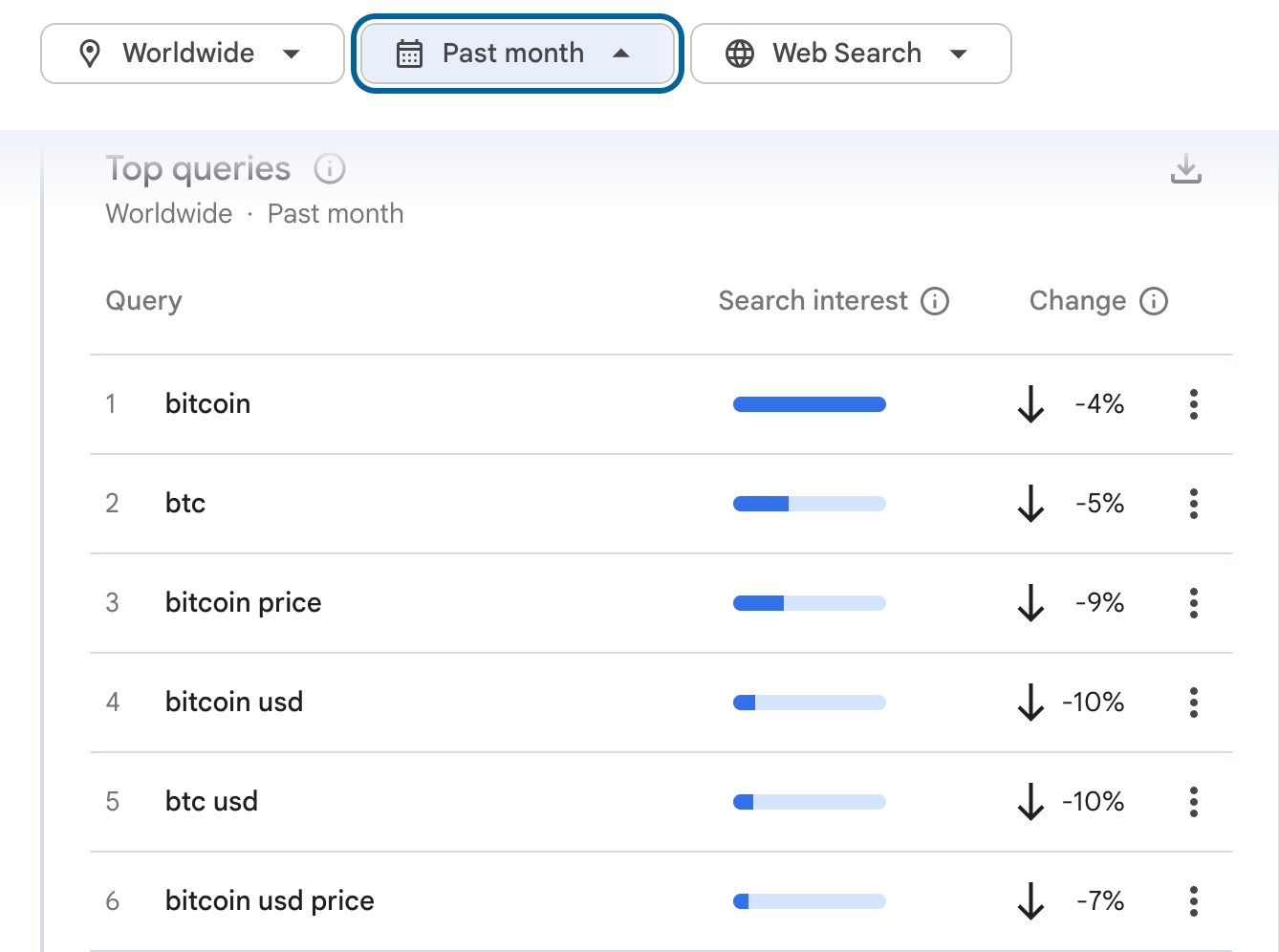
Right now, searches are down, but not by much. This suggests that retail investors are less active, though they aren’t completely giving up either. Seems more like a phase of waiting rather than panic.
If you want latest data, you can check the current trend here.
Social Media Insights
Social media offers an unfiltered view of Bitcoin sentiment.
Here’s what’s being said on X:
Bearish Sentiment
It's not just a random take, it’s a position gaining traction among traders who look at two months of failed breakouts at $76K and read it not as accumulation, but as exhaustion.
And then there's Peter Schiff, who has been calling Bitcoin a bubble and overpriced at every price point it has ever existed at.
It's a good tweet, structurally. It forces the bitcoin price speculation crowd to answer an uncomfortable question. Because sometimes the honest answer is: no particular news, the market is just digesting.
Peter Schiff's broader thesis hasn't changed in a decade: Bitcoin produces no cash flows, has no industrial use case, and its price is entirely a function of whoever's willing to pay more next.
Whether it's correct is a different question: Bitcoin has survived every Mr. Schiff’s tweet so far, but dismissing it entirely is exactly the kind of overconfidence that gets people wrecked at cycle tops.
Bullish Sentiment
Here’s an opinion that pokes four most acute pain points in the community right now, and is essentially a victory lap written in advance.
What this post is about: when Bitcoin breaks ATH again this year, four things will simultaneously be proven wrong - the 4-year cycle theory, quantum computing FUD, the "MicroStrategy must sell" narrative, and the timing instincts of everyone who sold and didn't buy back.
It's actually a confident framing. The subtext is that most of the current bear arguments are noise, not signal, and that the market keeps punishing people who try to be clever about exit timing.
Hot Topic
Michael Saylor’s recent purchase of 13,927 Bitcoin is sparking debate.
Some are skeptical about the legitimacy of the transaction, with critics demanding on-chain proof of the purchase.
The boring answer is OTC execution - institutional buys of that size clear away from public order books through counterparties who absorb volume gradually, which is why you don't see an immediate price impact.
No visible on-chain fingerprint doesn't mean the trade didn't happen. But in a market that runs partly on narrative and faith, "trust the process" is always going to have skeptics.
The net X read right now: cautious bulls holding the line, vocal bears getting their moment, and a large quiet cohort of people who bought somewhere between $80K and $100K just waiting for the chart to make a decision.
Bitcoin Technical Overview
Charts don't predict the future. They describe the past with enough confidence that people bet real money on them.
Here's what the bitcoin technical analysis picture actually looks like right now.
Moving Averages: Split Sentiment
Bitcoin is above its 7-day, 20-day, and 50-day moving averages, suggesting short- to medium-term momentum. However, it's still well below the 200-day moving average, currently around $91K.
This gap indicates short-term recovery but highlights a longer-term gap that needs to be addressed before we see more sustainable growth.
RSI: not panicking, not celebrating
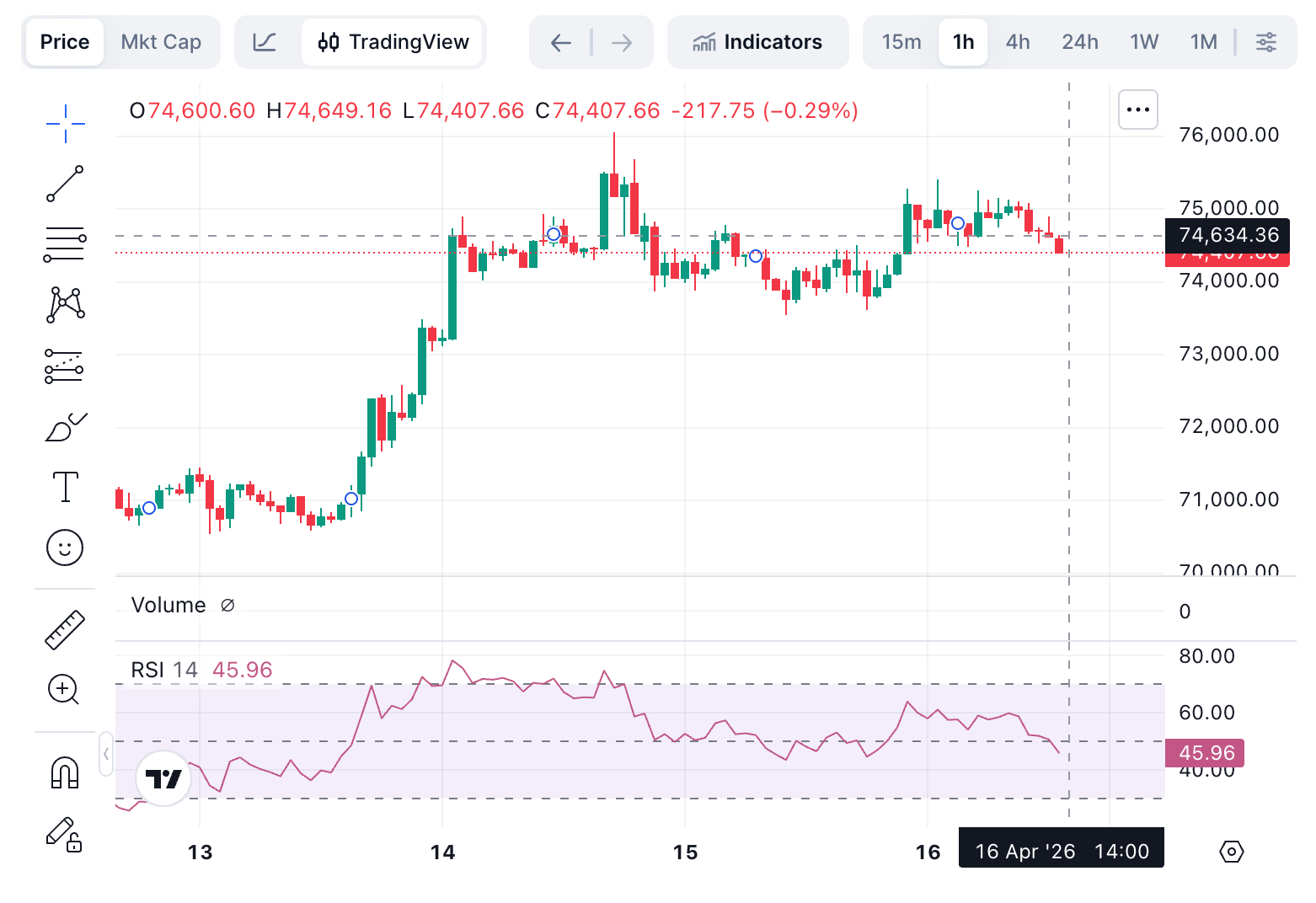
RSI is hovering around 49 - neither overbought nor oversold. This is constructive, as there is room for upward movement without triggering automatic sell signals.
That's actually a relatively constructive place to be. It means there's technical room to move up without triggering the automatic sell signals that come with readings above 70.
The $76K wall
Bitcoin has struggled to close above $76K multiple times in recent weeks, creating a significant resistance zone. A daily close above this level would be the first clear sign of a shift in market dynamics.
Bitcoin Price Prediction 2026–2030
No price targets or financial advice from us. What follows is what the people with skin in the game actually think, and why they disagree.
BTC Price Prediction 2026
2026 had a lot promised to it. Institutional money in, halving done, ETFs running, a U.S. strategic reserve on paper. And yet Bitcoin spent two months unable to close above $76K. At some point, narrative and price have to reconcile.
Joël Valenzuela, BD & Marketing Lead at Dash, shared his outlook exclusively with ChangeNOW:
"I don't believe Bitcoin will reach a new all-time high in 2026, for three key reasons.
First, this is the first of two bear years in the four-year cycle that Bitcoin has experienced since its inception. I would not expect a new all-time high for another several years.
Second, there needs to be a catalyst for growth. Bitcoin's narrative peaked over nation-state and institutional adoption, and we have seen strategic reserves fail to be implemented while El Salvador reversed its Bitcoin law. We would need a new growth driver.
Finally, digital asset treasury companies like Strategy may not be able to remain solvent during the whole bear market, and a few key capitulation instances could temporarily set Bitcoin's price back."
Joey King, Senior Developer at eCash, adds a more structural dimension - also exclusively for ChangeNOW:
BTC today leverages narrative over technology in a focused pursuit of price appreciation.
Unfortunately, there are diminishing returns. Bitcoin's intentional technical lag and its proximity to a potential price ceiling will prevent another 2017 or 2021-style boom. While the upside has shrunk, the downside has grown. New technical risks are again proving the impossibility of dev alignment to be a critical issue. Leveraged companies and custodial holding vehicles increase the risk of forced liquidations.
So yes. Bitcoin's glory days are over. Though there will still be some excitement for those paying attention.
Where Joël Valenzuela sees a cyclical problem, Joey King sees a structural one. Both arrive at the same destination from different directions.
The bulls aren't working from optimism alone, though.
Standard Chartered and Bernstein have both set 2026 targets at $150K, pointing to a structural supply vacuum as ETFs absorb liquid Bitcoin faster than new supply enters the market.
CoinShares models three scenarios: above $175K if the Fed returns to aggressive QE, $120–150K as the base case, and $75–90K if stagflation keeps risk appetite compressed.
The 2026 BTC price outlook ultimately comes down to one question: has institutional infrastructure genuinely changed the floor, or is it just delaying the test?
Bitcoin Price Prediction 2027–2028
By 2027–2028, the conversation shifts from sentiment to mechanics. The next halving lands in 2028. Supply tightens again. Four more years of ETF accumulation and corporate treasury strategies will have either built a real structural base or exposed the limits of that thesis.
Standard Chartered targets $400K by 2027, arguing the 2024 halving's supply impact is still playing out and historically felt most sharply 12–18 months after the event.
JPMorgan is more measured, pointing to Bitcoin's volatility relative to gold hitting record lows as a sign of maturation - their model implies a long-term range of $170–266K.
The counterargument is simple. A halving cuts supply. It does nothing for demand.
In a macro-driven market, demand depends on interest rates, dollar strength, and geopolitical stability - none of which Bitcoin controls.
The BTC growth potential in this window is real. The conditions required to unlock it are just more specific than they used to be.
Bitcoin Long Term Prediction 2029–2030
The further out the horizon, the more any price target resembles a bet on what kind of world we'll be living in.
Brian Armstrong, Coinbase CEO, sees Bitcoin reaching $1M by 2030, citing regulatory clarity, a U.S. government BTC reserve, and the growth of crypto ETFs.
ARK Invest revised its 2030 bull case down from $1.5M to $1.2M, citing stablecoins as a growing threat to Bitcoin’s dominance in payments.
By 2030, roughly 99% of all Bitcoin will have been mined. The supply side essentially closes. Price becomes almost entirely a demand story, and whether Bitcoin holds its store-of-value narrative against gold, stablecoins, and whatever asset class emerges next.
What Would Actually Need to Happen
Bullish Scenario
For Bitcoin to hit the numbers bulls are talking about, several things need to go right.
Here’s what could potentially turn the tides in Bitcoin’s favor.
- The Fed pivots for real. A sustained shift toward looser monetary policy that pushes capital back into risk assets. Bitcoin benefits disproportionately when the cost of holding cash goes up relative to the cost of not holding it.
- ETF inflows accelerate. Spot Bitcoin ETFs have already pulled in over $56 billion. The bull case requires the next wave: pension funds, endowments, sovereign wealth funds moving from "evaluating" to actually allocating. That's a different magnitude of capital than retail and early institutional buyers.
- Strategy doesn't blow up. Strategy holds over 714,000 BTC. If they stay solvent and keep accumulating, it's a structural buy signal. If they don't, the forced selling would be one of the largest single supply events in Bitcoin's history.
- A new adoption narrative. The nation-state story peaked and partially deflated. The next catalyst - BRICS reserve diversification, U.S. dollar debasement becoming undeniable, or a sovereign domino effect, needs to be real.
- The $76K wall finally breaks. Technically, a clean weekly close above resistance would flip a two-month narrative overnight. Markets move on momentum. One convincing breakout brings in the next wave of buyers.
The bullish scenario doesn't require a miracle. What it needs is several moderate probabilities all landing at the same time. Some of them are already partially in motion.
Bearish Scenario
Here’s what could cause Bitcoin to let down investors in the next few years:
- Tough economic conditions: High interest rates, persistent inflation, and a “risk-off” attitude could make Bitcoin less attractive. In this environment, institutional investors may find better places to put their money, slowing down ETF inflows and corporate investments in Bitcoin. This would quietly remove the buying pressure that supports its price.
- Strategy struggles: our friend from Dash, Joël Valenzuela, raised a valid concern: Bitcoin holders like Strategy, which holds over 714,000 BTC at around $76K per coin, might face pressure if Bitcoin stays below that price for too long. If they’re forced to sell, it would not only move the price lower, but it would also shake the confidence in institutional investors staying in Bitcoin long-term.
- Regulation setbacks: While the current U.S. government has been crypto-friendly, that could change. A single negative ruling from the SEC, or a new law that hurts crypto, could undo years of progress in a matter of months.
- Exchange failures: Major crypto exchanges or custodians failing, like what happened with FTX, could seriously damage trust. A big collapse would remind retail investors that size and reputation don’t guarantee safety, setting back trust in the market by years.
- Quantum computing threat: Although it’s not an immediate concern, powerful quantum computers could eventually break the cryptography that secures Bitcoin.
If that happens, the first target would be Satoshi’s early coins - over 1 million BTC sitting in wallets with exposed public keys.
The Bitcoin network would need to upgrade to quantum-resistant cryptography. While the development community is aware of this risk, finding a solution isn't simple and could be very challenging. - Bitcoin loses its edge: If other technologies like stablecoins (for payments), Ethereum (for programmability), or gold (as an inflation hedge) take over, Bitcoin’s appeal could shrink.
If Bitcoin is only seen as “digital gold but more volatile,” its potential market will get smaller, not bigger.
The Verdict
Bitcoin is a survivor. A 52% crash, two failed breakouts at $76K, a month of Extreme Fear, and yet it’s still hanging in there at $74K. Despite the chaos, the floor has held, and that’s no small feat.
The big question now is: What’s holding this thing up? Is it a solid institutional foundation, or just a temporary defense mechanism before the next drop? And when it comes to those $150K predictions, are they based on hard data or just optimism from people already long on Bitcoin?
The road to 2026–2030 is a split path. Is Bitcoin becoming a stable, maturing asset, or is it still a high-risk, high-reward trade? The $300K to $1.2M range for 2030 is a sign of two very different worldviews.
To really understand which side is likely to win, keep an eye on a few key indicators: ETF flows, funding rates, Fed policy, and sovereign reserve allocations.
These are the real signals that will shape Bitcoin’s direction before the price catches up.