

What Is the HYPE Token and How It Powers the Hyperliquid Ecosystem
This article explains what the HYPE token is, how Hyperliquid works, and how the token functions within the network.
The HYPE token has been living up to its name for two years, powering the Hyperliquid ecosystem. Holders can use it to stake with validators, vote on protocol changes, and earn rewards based on network activity. In short, HYPE is what keeps Hyperliquid running and growing.
Hyperliquid itself is a decentralized derivatives exchange built for perpetual futures trading. It runs an on-chain order book where traders place limit orders and see real market depth. Within this system, HYPE acts as the operational token that links staking, governance, and validator incentives.
Key Takeaways
- HYPE is the network token used inside the Hyperliquid ecosystem.
- The token connects traders, validators, and protocol incentives.
- Interest in HYPE rose alongside the growth of on-chain derivatives trading.
- As trading activity expands, staking, governance participation, and ecosystem rewards become more relevant for token holders.
What Is the HYPE Token
The HYPE token connects governance participation, staking mechanisms, validator incentives, and ecosystem reward programs.
Hyperliquid runs a decentralized exchange focused on perpetual futures with a fully on-chain order book.
Within this ecosystem, HYPE coordinates governance, validator incentives, and broader participation across the network.
Why the HYPE Token Is Getting Attention
HYPE started showing up on trader dashboards for a simple reason: activity around Hyperliquid picked up.
The token moves with the platform. When derivatives liquidity flows into the exchange, HYPE usually appears in the same conversations.
Price action made that visible.
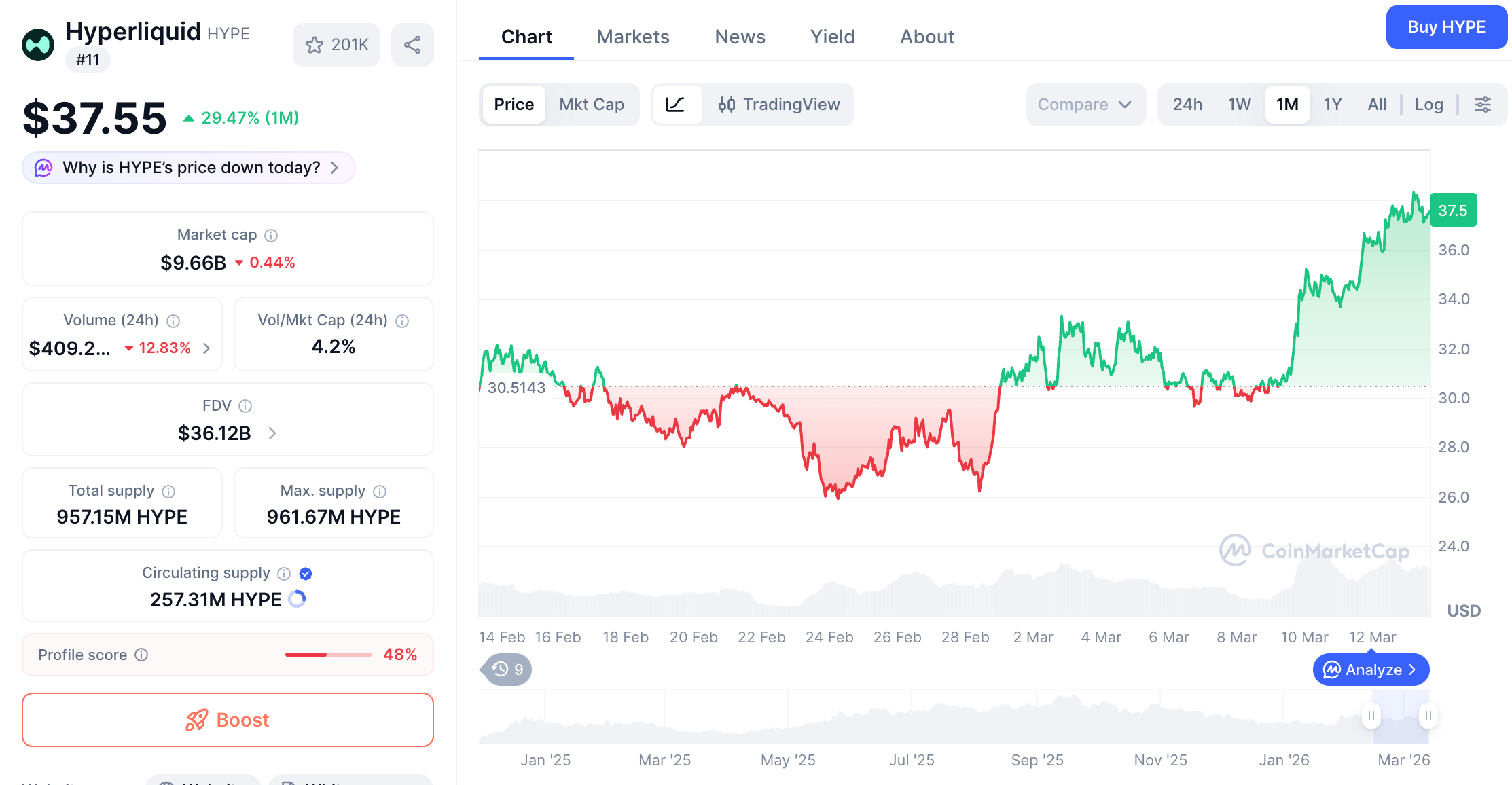
Source: CoinMarketCap.
Periods of higher trading volume around HYPE coincided with rising activity on Hyperliquid itself. That pattern is typical for exchange-linked tokens. When traders concentrate liquidity on a venue, the ecosystem asset tends to follow.
The trend extends beyond a single protocol.
The derivatives market in crypto has been expanding for years. Data tracked by DeFiLlama shows that perpetual futures regularly process tens of billions of dollars in daily volume across exchanges.
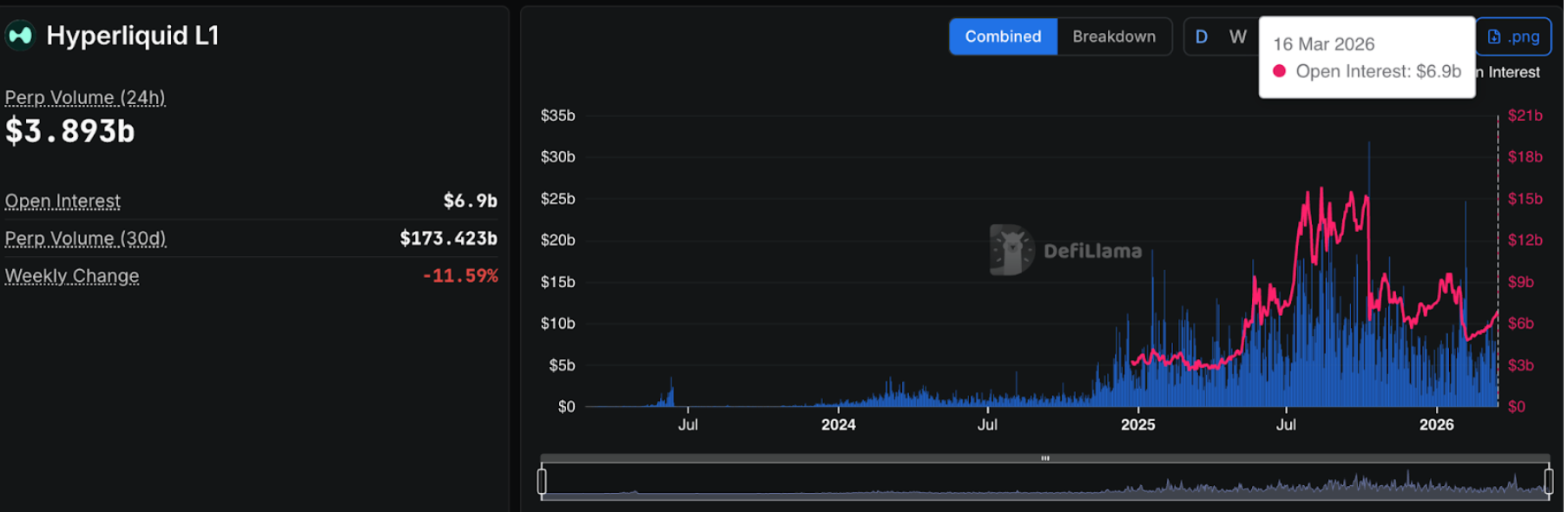
Source: DeFiLlama.
That market used to belong almost entirely to centralized exchanges. Now a portion of it is slowly moving on-chain.
Real-World Assets Are Already Driving Volume on Hyperliquid
Recent trading data from Hyperliquid shows a shift toward real-world asset derivatives. Perpetual futures tied to oil and silver exceeded $1.3 billion in daily trading volume, outperforming major altcoins like SOL and XRP on the platform.
- silver derivatives reached around $685 million
- WTI oil contracts accounted for $335 million
- Brent contracts added another $334 million
- total open interest across these markets approached $730 million
For comparison, Solana recorded around $181 million in trading volume, while XRP remained near $30 million over the same period.
This matters because non-crypto markets are starting to compete directly with crypto pairs for liquidity on the same platform. Hyperliquid is no longer limited to digital assets. It is becoming a broader derivatives venue where macro-driven instruments trade alongside crypto.
Unlike traditional markets, these contracts run continuously. Traders can react to price movements in oil, metals, or indices without waiting for market hours. That constant availability attracts a different type of liquidity — one that is driven by global events rather than purely crypto narratives.
As trading volume expands across these markets, the role of HYPE scales with overall platform activity. Staking, governance participation, and ecosystem incentives all depend on usage, which means broader market coverage can translate into stronger demand for the token.
At the same time, this shift introduces additional volatility. Liquidity tied to macro events can move faster and less predictably than crypto-native flows, especially during periods of geopolitical or economic stress.
Hyperliquid is part of that shift, with trading activity already extending beyond crypto-native markets.
Unlike most DeFi platforms built on liquidity pools, Hyperliquid runs a fully on-chain order book.
Traders place limit orders, watch real market depth, and interact with perpetual futures markets directly.
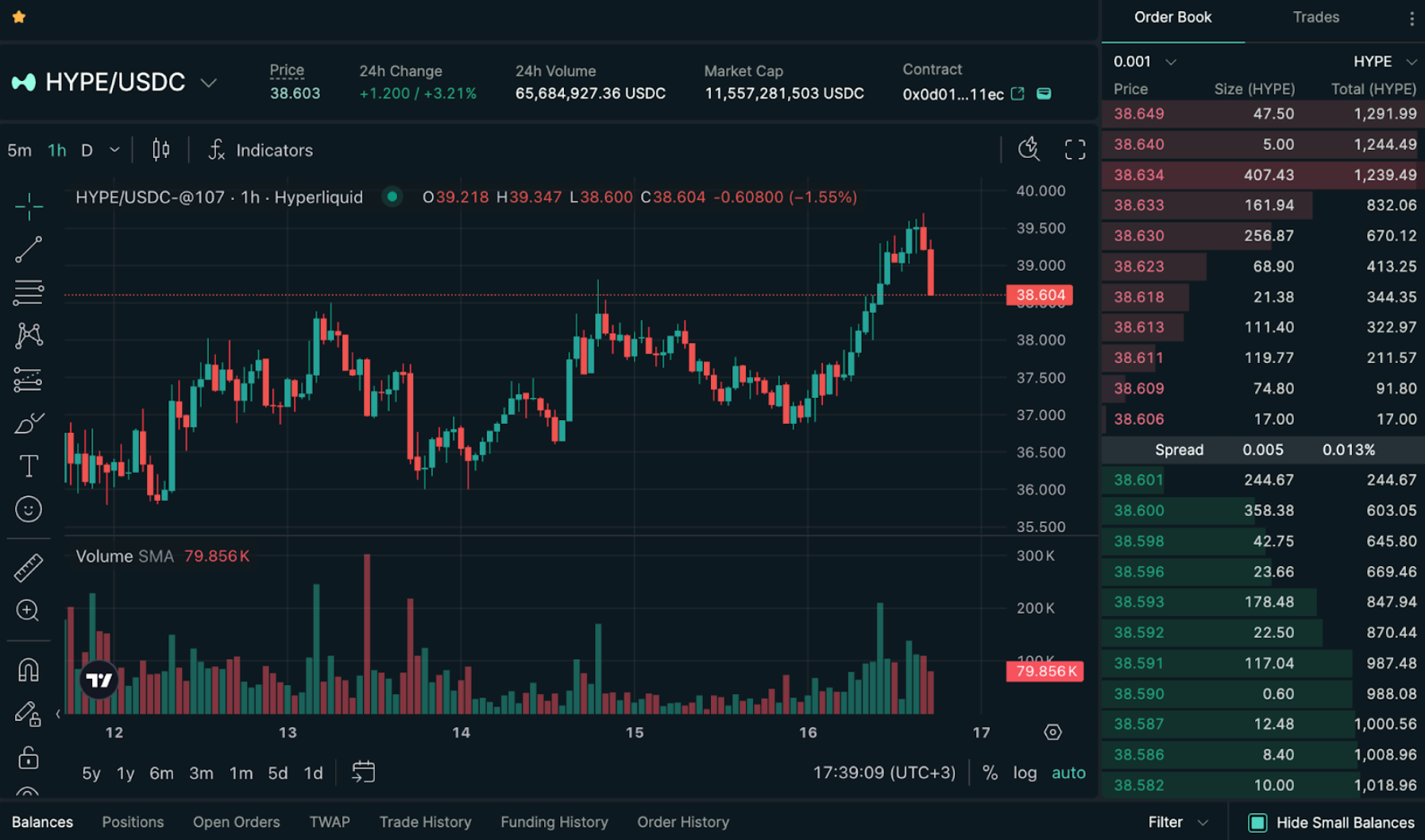
Source: Hyperliquid.
For traders used to centralized exchanges, the interface feels familiar. The difference is custody – assets remain in user wallets rather than exchange accounts.
As trading activity on Hyperliquid grows, the HYPE token tends to surface more often in market trackers, analytics dashboards, and trader discussions.
Part of the attention around HYPE also came from the Hyperliquid genesis distribution. About 31% of the total supply entered circulation through the initial community allocation, which quickly put the token on the radar of traders following on-chain derivatives markets.
Because the distribution focused on early users rather than private investors, it shaped the first holder base and influenced how the market perceived the token from the start.
HYPE Token Utility
The HYPE token supports several core mechanisms inside the Hyperliquid ecosystem:
- staking participation
- governance voting
- validator incentives
- ecosystem reward programs
Inside the network, HYPE links governance, validator incentives, and staking participation rather than functioning as a general payment token.
HYPE Tokenomics Explained
Tokenomics describes how the HYPE supply enters circulation and how incentives are distributed across the Hyperliquid network.
The total supply of HYPE is capped at 1 billion tokens. The distribution focuses on ecosystem growth, community participation, and development of the protocol.
| Allocation | Share |
|---|---|
| Ecosystem rewards | ~38.9% |
| Genesis distribution | ~31% |
| Core contributors | ~23.8% |
| Foundation | ~6% |
A large portion of the supply is reserved for ecosystem incentives, linking token distribution directly to trading activity and network participation.
Contributor allocations follow vesting schedules that release tokens gradually over time. This structure reduces immediate selling pressure and aligns contributors with long-term protocol development.
Staking rewards are funded partly through a future emissions reserve, which means dilution risk is not purely hypothetical even if unlock pressure remains gradual.
For many participants in the ecosystem, HYPE is less a passive holding asset and more a token connected to active participation in the Hyperliquid trading environment.
Real Use Cases of the HYPE Token
Beyond theoretical utility, the HYPE token appears in several practical scenarios inside the Hyperliquid ecosystem. It is not designed primarily as a payment asset. Instead, it connects users to operational mechanisms that support how the network runs.
These mechanisms include staking, governance participation, and reward programs tied to trading activity.
| Use Case | How HYPE Is Used | Why It Matters |
|---|---|---|
| Staking | Token holders can stake HYPE to support validator operations. | Strengthens network security and aligns incentives between participants and validators. |
| Governance | HYPE holders can participate in protocol governance through Hyperliquid Improvement Proposals (HIPs). | Allows the community to influence protocol development and upgrades. |
| Trading incentives | Active traders may receive ecosystem rewards tied to trading activity. | Encourages liquidity and sustained market participation. |
| Ecosystem rewards | Incentive programs distribute rewards to users who contribute activity or liquidity. | Supports long-term ecosystem growth. |
Validators maintain consensus across the network and verify transactions recorded on-chain. Token holders who stake HYPE support these validator operations and help secure the network.
Governance on Hyperliquid runs through Hyperliquid Improvement Proposals, though voting outcomes depend on stake distribution and participation.

Source: Hyperliquid Documentation.
Within this system, HYPE connects governance participation, validator incentives, and broader ecosystem activity as trading on the platform expands.
How Hyperliquid Infrastructure Supports the HYPE Token
To understand the role of the HYPE token, it helps to look at the infrastructure where it operates. Hyperliquid uses a different trading architecture compared with traditional crypto exchanges.
Most centralized exchanges rely on custody-based trading. Users deposit assets into exchange wallets, and the platform manages order execution internally. While this model offers speed and convenience, it also requires trusting the exchange with asset custody.
Hyperliquid approaches trading differently. The platform combines familiar exchange-style trading tools with on-chain execution and self-custody.
Because the HYPE token coordinates governance and incentives inside the Hyperliquid ecosystem, understanding this infrastructure helps explain where the token fits within the trading environment.
The following comparison highlights the structural differences.
| Feature | Hyperliquid | Centralized Exchanges |
|---|---|---|
| Custody | Self-custody | Exchange custody |
| Order book | On-chain | Off-chain |
| Transparency | Fully transparent | Limited |
| Infrastructure | Blockchain | Centralized servers |
| Trading model | Decentralized derivatives | Custodial derivatives |
This architecture shapes how the Hyperliquid ecosystem operates.
How to Buy HYPE
Users can typically acquire the HYPE token through several steps.
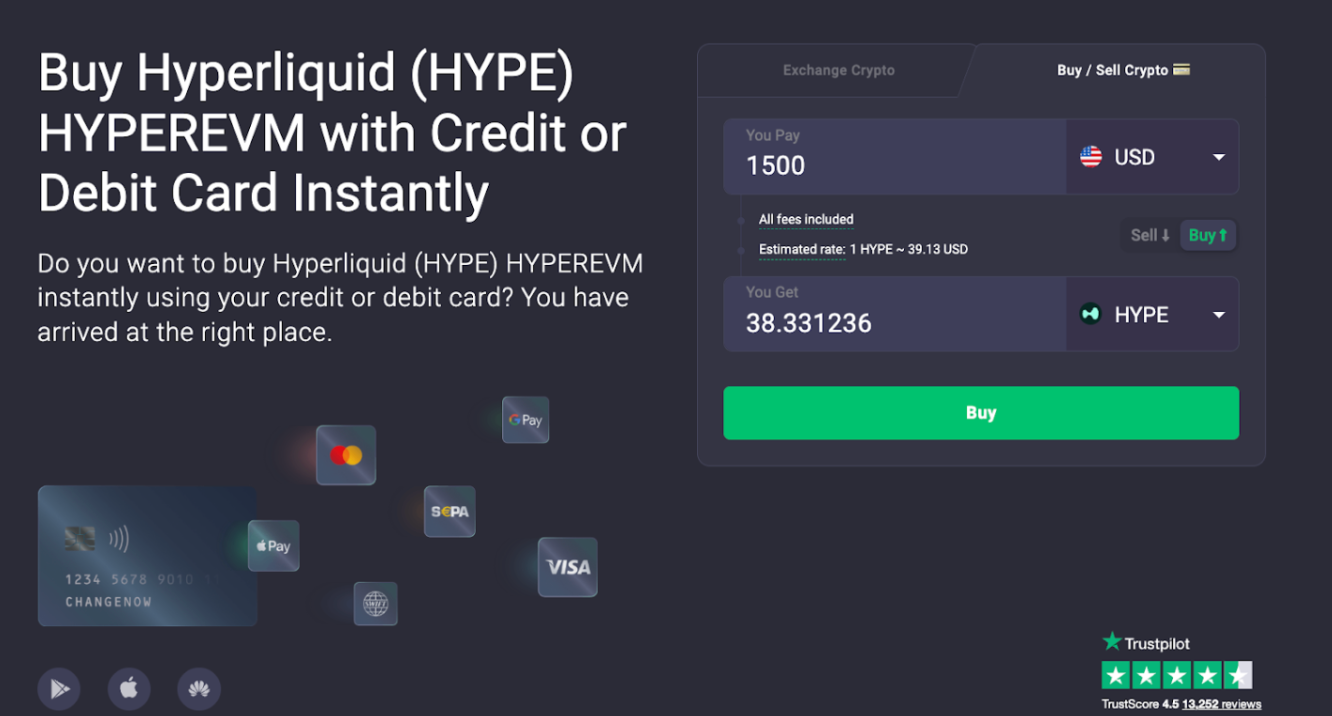
- Go to ChangeNOW
- Deposit cryptocurrency
- Purchase HYPE tokens
- Transfer tokens to a personal wallet if desired
Future of the HYPE Token
The long-term outlook for HYPE depends on whether Hyperliquid continues attracting trading volume to its derivatives markets.
As perpetual futures markets expand and more liquidity moves toward on-chain trading infrastructure, platforms capable of handling large derivatives volume will likely play a larger role in the DeFi market.
The development of additional infrastructure around Hyperliquid, including tools such as HyperEVM, could further expand the network’s capabilities and bring new applications and liquidity sources into the ecosystem.
If trading activity on the platform continues growing, demand for the HYPE token may increase alongside participation in staking, governance, and trading incentives.
People Also Ask
How do I stake HYPE?
HYPE holders can stake tokens to support validator nodes. Staking requires a minimum amount of HYPE and a short lockup period. Rewards are distributed daily and reinvested automatically.
What is the minimum HYPE needed to participate as a validator?
Validators must stake at least 10,000 HYPE to run a node and participate in network consensus.
How can I participate in Hyperliquid governance?
Token holders can vote on protocol upgrades via Hyperliquid Improvement Proposals (HIPs), influencing changes to trading rules, fees, and network parameters.
Is Hyperliquid decentralized?
Yes. Hyperliquid operates as a decentralized trading infrastructure where users maintain custody of their assets while interacting with derivatives markets.
Does Hyperliquid charge trading fees?
The platform uses its own fee structure designed to support derivatives trading activity.
What trading incentives exist for HYPE holders?
Active traders may earn rewards from ecosystem programs tied to liquidity provision and trading activity. These incentives encourage market participation and deeper integration into the network.
Which wallets support the HYPE token?
HYPE can be stored in wallets that support the Hyperliquid ecosystem and its network infrastructure. Users typically connect compatible Web3 wallets when interacting with the platform, allowing them to trade, stake tokens, and participate in governance while keeping custody of their assets.