




Bitcoin’s old wallets made the quantum risk easier to see.
Nothing has broken yet, but exposed public keys tied to inactive wallets create a migration problem: there may be no owner left to move the coins when the signing model changes.

Bitcoin’s old wallets made the quantum risk easier to see.
Nothing has broken yet, but exposed public keys tied to inactive wallets create a migration problem: there may be no owner left to move the coins when the signing model changes.
Now the same question moves into the rest of crypto, where wallets, bridges, stablecoins, validators, and exchanges still need to run while the math changes.
Our full Bitcoin quantum threat breakdown covered Bitcoin’s hardest edge case: exposed public keys, dormant BTC, Satoshi-era coins, and old wallets with no active owner to defend them.
One private key controls one wallet. Lose the key, and the coins stay locked. Expose the public key for long enough, and future quantum hardware may turn that old safety model into a timing problem.
Across the rest of crypto, ownership routes through more systems.
Stablecoins move across TRON and Ethereum. Validators sign blocks. Bridges rely on control keys. Smart contracts route funds through systems most users barely inspect.
What breaks first when the upgrade touches old balances, deposit rules, signing formats, custody policies, and liquidity?
A quantum computer does not need your seed phrase.
Public keys and signatures are the weak point.
A wallet proves control through a digital signature. Once a public key becomes visible, a strong enough quantum computer could try to derive the private key from it.
Can the owner rotate keys or move funds before the key can be attacked?
The same exposure can touch validator keys, bridge admin keys, exchange hot wallets, smart contract wallets, old address formats, and custody systems.
Cold storage still helps against phishing, malware, bad extensions, leaked devices, and sloppy key handling.
It does not fix protocol-level exposure after a public key becomes attackable.
Project Eleven’s 2026 blockchain report describes Q-Day as the point when a cryptographically relevant quantum computer can break existing public-key cryptography.
Exposure to quantum threat depends on the following things:
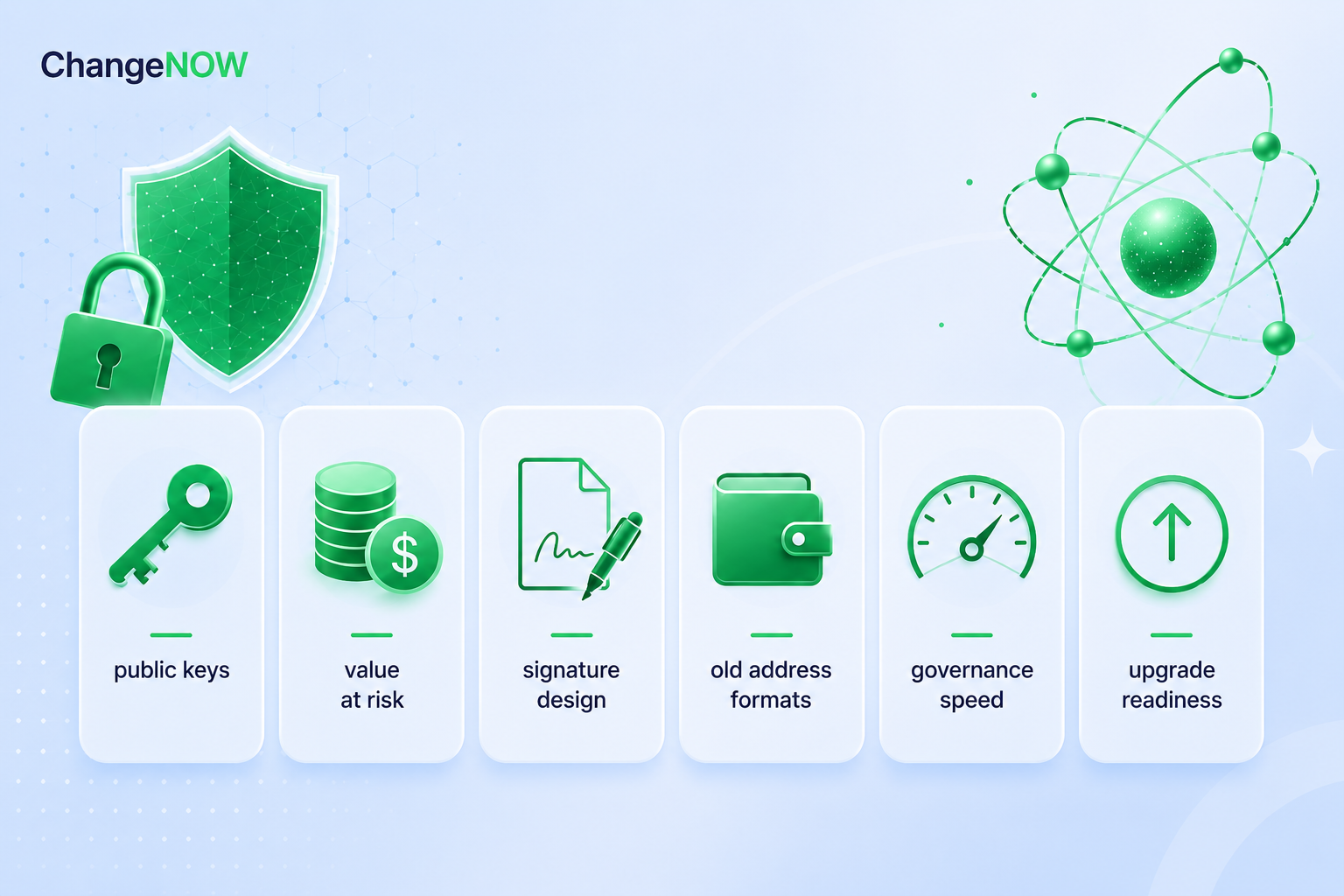
Research helps only when the upgrade path reaches deposit rules, signing tools, validator clients, hardware devices, and old balances.
qLABS publishes the Layer-1 Quantum Vulnerability Index, a ranking based on public blockchain data and a five-part scoring model. The score runs from 0 to 10. A higher score means higher post-quantum exposure under the qLABS methodology.
Here's the table that tracks exposure signals. The table doesn’t certify chain security though.
| Blockchain | qLABS Score | What Readers Should Watch |
|---|---|---|
| Bitcoin | 8.33 | BIP proposals, old-address handling, wallet migration tools |
| Hyperliquid | 7.90 | Foundation roadmap, validator and security updates |
| BNB Chain | 7.87 | Foundation updates, wallet and exchange support |
| Dogecoin | 7.77 | Developer activity and formal proposals |
| Monero | 7.37 | Signature migration plans |
| TRON | 6.83 | USDT routing, wallet support, roadmap updates |
| Ethereum | 6.80 | Account migration, client support, PQ roadmap |
| XRP Ledger | 6.30 | Timeline, key rotation, wallet rollout |
| Solana | 6.00 | Validator roadmap, wallet updates |
| Cardano | 5.60 | Formal upgrade path and implementation |
Cardano can score lower in one index and still need a post-quantum path.
Under qLABS, the top 10 chains don’t really differ in terms of basic signature flaws or public-key risks. The differences we see are mostly due to economic scale, past security incidents, and how ready they are for migrations.
Bitcoin still matters most as the clear high-risk case: large value, old exposed keys, dormant coins, and hard migration politics.
Ethereum has a different shape of risk. The DeFi and account surface is huge, but its public research activity gives readers more to track than silence.
TRON affairs because stablecoin routing gives the chain a large payment footprint. The risk is not only the chain token. It is the rails moving value through it.
IT-Online reported, based on TechGaged and qLABS data, that more than $2.5 trillion in crypto market value may sit on chains that are not fully quantum-protected.
Changing signature rules on a live L1 touches a lot of sensitive areas like:
A rushed migration can strand users. A messy fork can split liquidity.
Delay usually comes from 4 places:
“Fork later” only works if the chain already knows what later looks like.
A delayed upgrade creates less work today, but it can leave fewer safe options once pressure arrives.
qLABS’ Q-Day playbook treats migration as an ecosystem coordination problem. For blockchains, the same pressure hits wallet teams, exchanges, custodians, infrastructure providers, validators, and users at once.
What does a quantum-resistant claim actually cover?
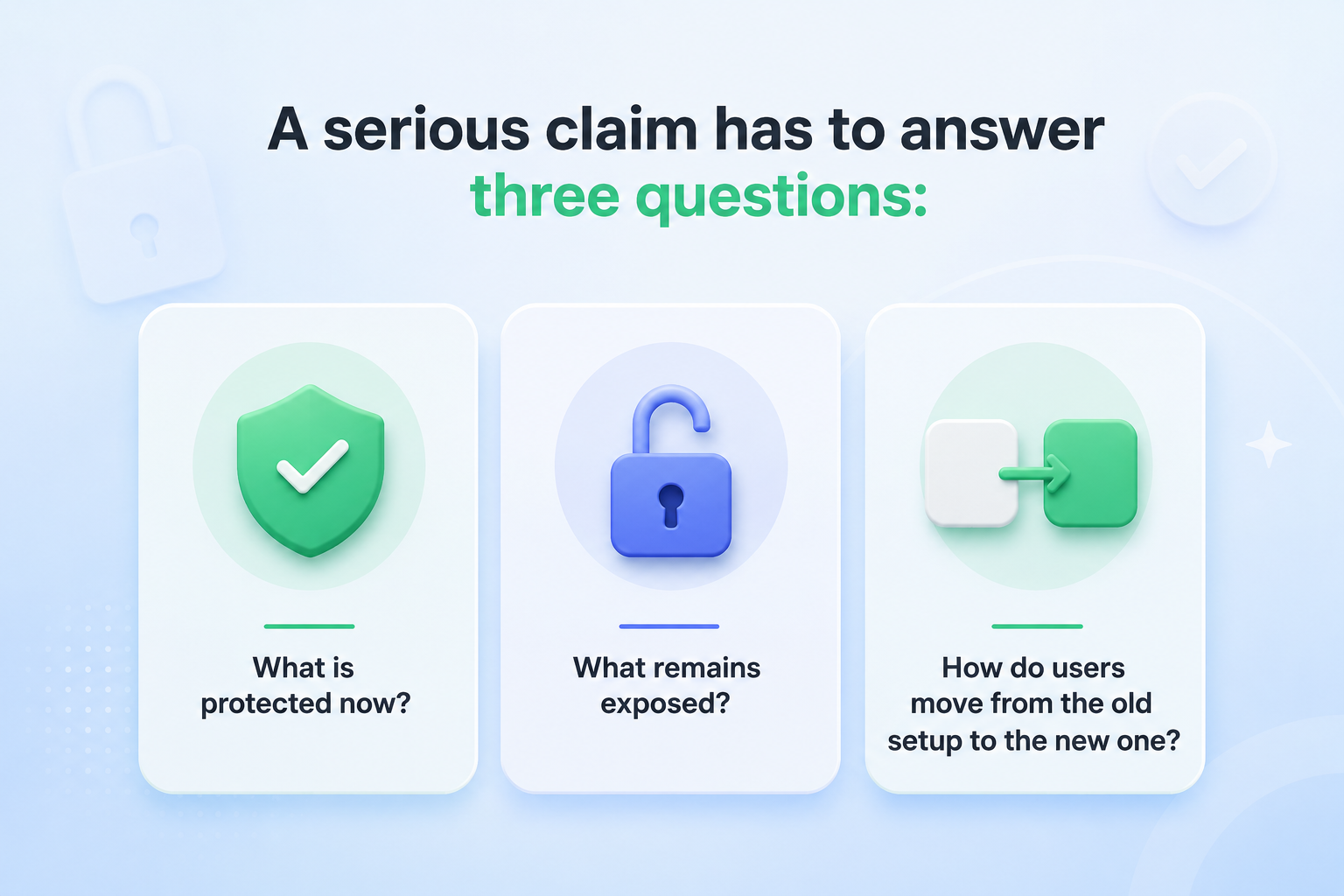
The algorithm is only useful if the market can run it. Old users may never migrate. Inactive wallets may never notice.
A serious rollout needs client teams, signing tools, deposit support, audits, documentation, and a route for old balances.
NIST approved three post-quantum cryptography standards in 2024: FIPS 203, FIPS 204, and FIPS 205.
Here's what you need to pay attention to as well.
| Readiness Level | What It Means | Reader Translation |
|---|---|---|
| No visible plan | No roadmap, no proposal, no migration talk | No proof yet |
| Risk acknowledged | Team admits quantum matters, but no route yet | Better than silence, still weak |
| Roadmap phase | Research, proposal, or target direction exists | Watch execution, not PR |
| Partial implementation | Some PQ tools exist in accounts, proofs, wallets, or modules | Progress, not full coverage |
| Protocol-level PQC | Chain uses post-quantum signatures at the base layer | Stronger setup, still needs liquidity and adoption |
The “quantum-resistant” label covers very different projects.
Tangem’s May 2026 quantum-resistant crypto watchlist includes QRL, IOTA, Abelian, Cellframe, Algorand, Hedera, and QANplatform.
QRL and Abelian were built around post-quantum signatures from the start.
Algorand and Hedera have separate PQC work inside larger networks. IOTA, Cellframe, and QANplatform still need a live check: what runs now, what sits in docs, and what users can actually use.
The projects fall into different buckets.
| Category | Projects | What It Means | Main Risk |
|---|---|---|---|
| Built For PQC | QRL, Abelian | PQC sits close to the base design | Weak liquidity, limited listings, low user activity |
| Partial PQC | Algorand, Hedera | PQC covers only part of the network | One protected feature may look like full-chain protection |
| Roadmap Or Claim | IOTA, Cellframe, QANplatform | Quantum security is still mostly a stated direction | Docs and claims may run ahead of shipped protection |
For traders, the table is the main check. A quantum-resistant claim is not enough without wallets, listings, liquidity, audits, and active development. Thin order books, weak exchange access, wide spreads, or unclear docs can turn a strong security claim into a bad trade.
For traders, quantum risk works better as a research filter than a panic signal.
One scary headline does not justify panic-selling. One “quantum-safe” label does not justify aping into a thin book.
Track:
Keep the basic wallet checks in place.
Avoid address reuse where possible. Keep wallets updated. Follow hardware wallet notices. Track exchange and custody announcements.
Phishing still costs users more money today than quantum computers do.
Q-Day is not one fixed date everyone agrees on.
Project Eleven’s 2026 model gives three timing scenarios: 2030, 2033, and 2042.
That range is wide, but crypto migration is slow enough for the range itself to matter.
Market pressure may show up through deposit rules and custody policies before any stolen-coin headline.
Watch closely for:
Infrastructure may react before wallets get drained.
Bitcoin made the quantum problem visible because old public keys and dormant coins are easy to understand.
Live chains add a harder layer. Stablecoins, bridges, validators, smart contracts, wallets, exchanges, and custody systems all need upgrade routes that users can actually follow.
Does the chain have a public plan? Do wallets support it? Can exchanges handle deposits? Is there a route for old users and old balances?
If the answer is still vague, “quantum-resistant” is mostly a claim at this point.
It’s no secret that Bitcoin and other cryptocurrencies have found their way into many households worldwide.
Crypto Regulations in Different Countries
Discover crypto regulations worldwide | Compare laws on trading, taxation, and digital assets

Cryptocurrency in the UK: Legal Status, Adoption & Top British Crypto Projects
Is crypto legal in the UK? Discover the current status of Bitcoin and Ethereum, top UK-based blockchain projects, and how the FCA regulates the crypto industry in 2025