


How to Scale a Crypto Business with Crypto Partnerships
Monetize your audience and unlock a new revenue stream. Integrate ready-made exchange infrastructure to scale your crypto business without inflating acquisition costs.

Crypto markets are not easy to grow in. Acquisition costs increase over time, and performance from paid channels rarely stays stable for long. Relying only on advertising eventually narrows margins, especially in competitive segments where crypto businesses operate.
At the same time, building an internal exchange infrastructure is not a trivial decision: liquidity, cross-chain support, and maintenance require ongoing focus. Not every team wants growth to depend on increasing its technical footprint. Partnership models offer another option, creating new business opportunities. Instead of chasing incremental traffic, a business can rethink how it monetizes existing users and product activity. In this article, we examine how affiliate and partnership structures work in practice, how to assess them realistically, and how they can support growth without forcing every new capability to be built in-house.
Key Takeaways
- Stop thinking of scaling as just "more users." Giving your current users more to do is just as important as getting new ones through the door.
- Pick your partners based on what’s actually broken. Whether it’s a swap or an onboarding, the model needs to address a real pain point.
- Depth defines the impact. A referral link is just a band-aid for revenue; if you want to change your core metrics, you need to integrate via API.
- Forget high commissions if the backend is trash. Accurate reporting and stable infrastructure win every time.
- If the partner doesn't get your user behavior, the collab is going to fizzle out. It’s all about product alignment.
- Transaction volume and retention are your real north stars.
Traditional marketing VS Partner Programs
Marketing will always play a role in growth. Campaigns attract attention, generate initial traffic, and help position a product within a crowded market. But over time, advertising alone does not change a business's structure. It does not add liquidity. It does not expand functionality. It does not increase the range of services a platform can provide.
A strong business strategy for Web3 addresses a different layer of growth. Instead of repeatedly paying for visibility, a company can integrate services that expand what users can do within the product itself. That integration can be lightweight — for example, through referral agreements — or deeper, such as embedding exchange infrastructure directly into the interface.
A well-designed affiliate setup aligns incentives without requiring heavy upfront spending, tying revenue to usage rather than impressions. For crypto products, API integrations go further by enabling transaction activity within the existing environment, expanding functionality alongside revenue. In some cases, such partnerships may also include coordinated marketing or PR, providing access to a partner’s distribution channels in addition to technical integration.
Traditional Marketing vs Affiliate & Partnership Models
| Traditional Marketing | Affiliate & Partnership Models | |
|---|---|---|
| Pros | Direct control over campaigns and messaging | Lower effective CAC through revenue sharing |
| Immediate traffic generation | Expanded distribution through partner networks | |
| Brand awareness growth | Increased transaction volume via embedded tools | |
| Cons | Rising acquisition costs | Requires technical or strategic alignment |
| Campaign performance volatility | Revenue depends on partner performance | |
| Limited impact on liquidity or product scope | Needs ongoing monitoring and optimization | |
| Advertising restrictions in crypto markets and platform policy limitations | Incorrect partner selection may introduce reputational risk |
How Crypto Affiliate Programs Work for Business Owners
A crypto company builds something more valuable than traffic: an active user base. They read the content, use the product, and return to it. Over time, that activity becomes predictable. Instead of sending those users elsewhere for additional services, a business can keep them inside its own environment.
Affiliate and cryptocurrency partnerships make that possible in different ways. A referral model is the simplest — a user follows a link and completes an action on another platform. A widget keeps more of that flow on-site. API integration goes further, placing exchange functionality directly within the product interface. The difference is practical: the user does not leave, and the platform does not lose visibility into the transaction flow.
Integration can expand what the product offers without building an exchange layer from scratch. Swaps, cross-chain operations, or fiat access can be added through coordination rather than internal development. Choosing the right structure depends on how much control, technical depth, and long-term involvement a team is willing to commit to their web3 business optimization. For example, here you can learn more about how ChangeNOW Powers Cross-Chain Swaps Inside Agent Hustle AI.
What fits best for your crypto business
Not every crypto partner program fits every product model. The right partnership depends on how your business generates value and how users interact with it.
A wallet solves custody and asset management. An exchange focuses on liquidity and trading access. A DeFi protocol optimizes yield mechanics. A payment gateway concentrates on transaction processing. Each of these models encounters different growth constraints, and each benefits from a different type of partnership.
Choosing correctly requires looking at where friction occurs in your current user flow. Do users leave your platform to swap? Is onboarding the bottleneck? Does distribution limit adoption? The partner should address a structural gap, not introduce an additional feature that users do not actively need.
The following sections outline how different types of crypto businesses scale through targeted partnerships aligned with their operational logic and audience behavior.
Crypto Wallet (Hot/Cold Wallet)
Recommended Partnership: Exchange (DEX)
Wallets are, by definition, user-controlled environments. Their value lies in custody, asset visibility, and direct interaction with blockchain networks. What they often lack is native exchange functionality that matches the expectation of immediate asset conversion. Users who cannot swap inside the wallet usually turn to external platforms. Each redirection introduces friction and increases the likelihood of drop-off.
A DEX integration is consistent with the non-custodial logic of most hot and cold wallets. Instead of positioning the wallet as a storage endpoint, the product becomes an access point to market liquidity. The exchange flow happens within the same interface, and private keys remain under user control. For wallets that aim to support Web3-native users, this model reflects how people already interact with assets: storing, swapping, redeploying.
For teams, the benefit is structural rather than promotional. The wallet does not need to operate order books or manage liquidity internally. It connects to existing liquidity infrastructure while preserving its primary role as a secure environment.
Benefits of integration:
- Becomes the default gateway to DeFi ecosystems. Users can move from holding assets to participating in DeFi strategies without leaving the wallet. Reducing friction at this step often increases functional usage.
- Transaction revenue. Embedded swaps introduce a new revenue layer tied directly to transaction flow. Compensation models are typically based on volume rather than impressions.
- User retention. When swapping is available inside the wallet, fewer users migrate to competing interfaces to complete basic asset operations.
- Reduced dependency on external redirects. Keeping transactions in-app improves visibility into user behavior and enables more accurate performance analysis.
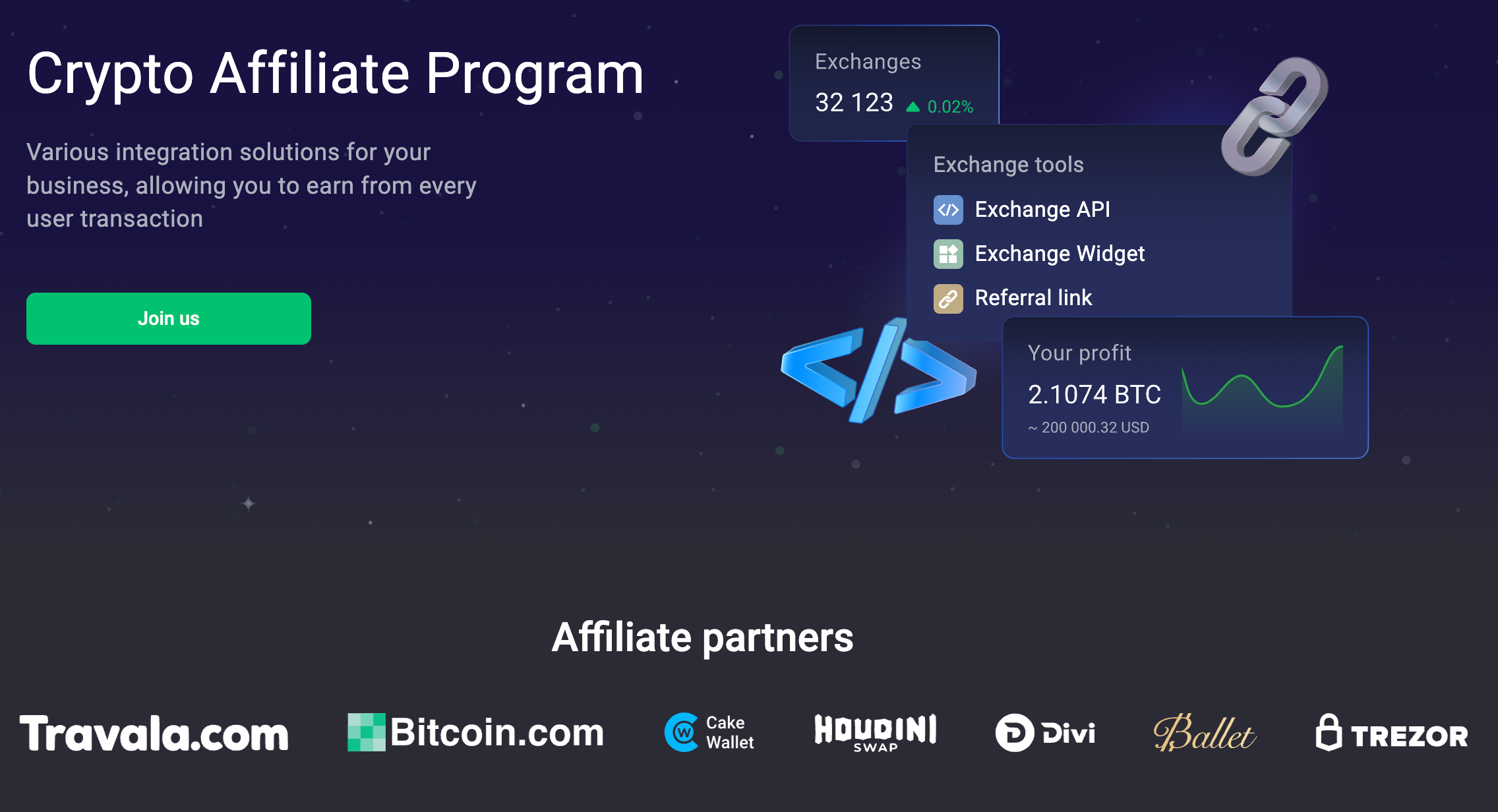
Teams looking to add exchange functionality without building independent infrastructure can evaluate programs such as the ChangeNOW Affiliate Program, which provides access to aggregated liquidity through API-based integration.
Cryptocurrency Exchange (CEX/DEX)
Recommended Partnership: Payment Service Providers & Fiat On-Ramps
For exchanges, growth is often constrained at the entry point. Liquidity, matching engines, and trading pairs can be optimized internally, but onboarding remains the first barrier. If users cannot fund their accounts quickly, they do not reach the trading interface at all. In many regions, card payments and local transfer methods are the decisive factor.
Integrating payment service providers and fiat on-ramps addresses this structural limitation. Instead of requiring users to acquire crypto elsewhere, the exchange enables direct purchase within its own environment. This shortens the path from registration to the first trade and reduces the likelihood that new users abandon the process before depositing funds.
For both centralized and decentralized exchanges that provide hosted interfaces, fiat access serves a practical purpose. It widens the addressable audience beyond crypto-native participants and makes the platform accessible to users who operate primarily in local currencies.
Benefits of integration:
- Instant user onboarding. Card payments and local methods allow new users to move from signup to asset ownership without external transfers.
- Revenue share model. Many fiat providers operate on a transaction-based compensation structure. A portion of the fiat-to-crypto conversion fee can become an additional revenue stream tied to deposit activity.
- Aligned incentives. Payment providers seek transaction volume. Exchanges seek funded accounts and active traders. The integration aligns these objectives without changing the exchange’s core trading logic.
- Lower friction for global expansion. Supporting region-specific payment methods reduces dependency on a single banking channel and makes local market entry more predictable.
When structured carefully, fiat partnerships strengthen the foundation of an exchange: funded accounts, higher activity, and fewer abandoned registration flows.
DeFi Protocol (Lending/Borrowing/Yield)
Recommended Partnership: Centralized Exchanges
Many DeFi protocols are technically accessible but operationally complex for first-time users. Before interacting with lending pools or yield strategies, a user may need to acquire specific tokens, bridge assets, and connect multiple wallets. Each additional step reduces completion rates.
A partnership with centralized exchanges can simplify the initial interaction. CEX platforms already aggregate large user bases and handle fiat onboarding, custody during onboarding, and identity checks where required. When a DeFi protocol is accessible through a centralized exchange interface or supported via token listings and direct integrations, the user journey becomes shorter: acquire asset- allocate to product.
From a protocol perspective, such cooperation is not about abandoning decentralization principles. It is about reducing the technical barrier that prevents capital from reaching on-chain products. Liquidity and total value locked (TVL) are influenced not only by yield rates but by how easily users can enter the ecosystem.
Benefits of integration:
- Instant access to a broader user base. Exchanges operate established distribution channels. Integration or listing can expose the protocol to users who may not otherwise navigate directly to DeFi interfaces.
- Improved liquidity and TVL dynamics. Simplified access to protocol tokens or staking mechanisms can support more consistent inflows of capital.
- Simplified user experience. Bridging, token acquisition, and wallet setup can be reduced or partially abstracted when exchanges provide structured entry points.
- Operational clarity. Working with established exchanges provides clearer reporting structures and more predictable conversion tracking than purely community-driven traffic.
For DeFi teams aiming to scale responsibly, partnerships with centralized exchanges can function as a controlled gateway rather than a replacement for on-chain engagement.
Crypto Payment Gateway
Recommended Partnership: E-commerce Platforms & SaaS Companies
A payment gateway is rarely limited by technology alone. The constraint is usually distribution: how many merchants integrate the gateway and how often end users choose crypto at checkout. Expanding through direct marketing can support awareness, but long-term scale depends on being embedded where transactions already occur.
Partnerships with e-commerce platforms and SaaS providers address this dynamic. Instead of integrating merchants individually, a gateway connects to systems that already serve thousands of businesses. The integration becomes part of the platform’s checkout or billing logic, enabling crypto acceptance at scale. This model shifts focus from single-client acquisition to ecosystem-level enablement.
For payment gateways operating in Web3 and beyond, such partnerships reduce reliance on outbound sales. They introduce structured access to merchant networks that value deployment speed and stable settlement flows.
Benefits of integration:
- Lower effective acquisition cost. Accessing merchant bases through platform partnerships reduces the need for direct one-by-one onboarding.
- Scalable revenue model. Transaction-based compensation accumulates across multiple merchants without proportional growth in operating expenses.
- Faster deployment cycles. Standardized plugins or API integrations allow merchants to activate crypto payments without deep technical implementation.
- Expanded market reach. Platform integrations often include geographic coverage and payment method support that would demand considerable resources to build independently.
For payment gateways, scale is achieved not by promoting crypto payments, but by making them available in environments where checkout decisions are already being made.
The Step-by-Step Guide to Crypto Partnerships
Structured partnerships are easiest to get wrong when they start as an afterthought. A banner and a link can work, but they rarely change the economics of a product. For a crypto platform, the useful question is simpler: what can we add that users will actually use — and what will that change in revenue and retention?
Step 1. Audit Your Audience
Start with the product reality. What do users come to you for, and what do they try to do next? Swaps, cross-chain moves, fiat access, and staking — these needs appear throughout different segments and at different points in the user journey.
If the partnership adds something that your users already look for, you keep activity inside the product. If it doesn’t, it becomes noise. Audience fit is the difference between a program that earns quietly for months and one that never leaves the dashboard.
Step 2. Choose the Best Crypto Affiliate Program
Most programs look similar on the surface. The differences that matter show up later.
- Audience fit. Will this service match how your users transact—frequency, ticket size, risk tolerance?
- Commission model and payouts. Is the revenue share logic clear? Are payouts consistent with the volume you can reasonably expect?
- Brand and operational stability. You are attaching another service to your product. Reliability, incident history, and compliance posture matter more than marketing claims.
- Technical depth. If you run a product, not a content site, deeper integration often outperforms simple referrals. API options tend to give more control over the user flow.
- Tracking and attribution. You should be able to verify the volume's source. Cookie duration matters for link-based models; API attribution matters for embedded flows.
If you need a broader evaluation framework, covering infrastructure reliability, liquidity access, compliance, and scalability, see our guide on How to Choose a B2B Crypto Exchange Provider, which explains the key factors to consider beyond commission structures. If you want to compare options in one place, our overview of the top crypto affiliate programs summarizes payout structures and integration formats across the market.
Step 3. Integrate & Disclose
Treat implementation like any other product change. Settle on the use case, read the docs, configure keys or widgets, test in a sandbox, then ship.
Disclosure depends on the format and your audience. For B2B teams, transparency is also a trust signal: users notice when a “feature” is actually an external service. The cleaner the process and the clearer the explanation, the fewer support issues you inherit.
Step 4. Analyze Results
If you cannot measure it, you cannot improve it. At minimum, track:
- transaction volume driven by the integration
- conversion from active users into transactions
- revenue per active user
- retention signals (if you can link cohorts)
- what the revenue looks like compared to what you’d pay for the same activity via paid channels
Don’t rely on one dashboard. Pair partner reporting with your own analytics, then validate attribution. After that, iterate on placement, onboarding, contextual prompts, and the point in the journey at which the feature becomes visible.
Step 5. Scale Results
Scaling is usually not “add more programs.” It’s tightening what already works.
If the integration converts, expand it where it makes sense: improve UI visibility, add supporting content, and remove friction from the flow. Only then consider additional services — ideally, those that strengthen the same user journey instead than fragment it.
The best partnership stacks look coherent to the user. They feel like a product getting stronger, not a marketplace of add-ons. Over time, that’s how affiliate and partner models stop being experiments and become a stable revenue line.
How our Partner Boosted Their Revenue by 3 BTC with the ChangeNOW Affiliate Program
One of our partners, who chose to remain anonymous for this article, initially aimed to launch its own exchange functionality as part of its crypto business plan. After assessing the scope of work — liquidity management, backend reliability, and ongoing maintenance — the team decided not to build a separate exchange layer at that time.
Instead, they integrated exchange functionality through the ChangeNOW affiliate model. Swaps became available within their interface, without developing independent infrastructure. Over time, this integration increased monthly trading volume to 3 BTC, while the team continued to focus on their core roadmap.
The partner described this experience as:
“ChangeNOW is already a proven partner. Working together helped us strengthen end-user trust while keeping the process simple.”
Conclusion: Scaling Your Crypto Business with Affiliate and Partnership Programs
Scaling a crypto company rarely depends on a single lever. Traffic matters. Product depth matters. So does how revenue is structured. Partnership models — including affiliate arrangements — add another dimension: they connect user activity to additional services without requiring every capability to be built internally.
For teams running wallets, exchanges, or Web3 applications, the question is not whether to participate in affiliate programs in general. It is determining which structure fits the product and how deeply it should be integrated. Some situations call for referral links. Others benefit from embedded tools or API integration.
When partnerships are deliberately chosen and consistently monitored, they become part of how the product evolves—not an attachment but an extension of it.
Don't let rising acquisition costs limit your growth. Build with ChangeNOW’s Partners solutions and monetize your existing audience through a secure, ready-to-deploy infrastructure.
FAQ
How do crypto partnerships help with user retention?
Retention improves when users no longer need to leave your product to complete core actions. When swaps, fiat onboarding, or liquidity access are embedded directly into a platform, engagement typically increases.
For many teams scaling a crypto business, partnerships work not because they generate commissions, but because they extend the product itself. A well-organized crypto partner program reduces friction at the interface and keeps transaction flow within your ecosystem, rather than redirecting it elsewhere.
What's the main difference between a simple referral link and a deep partnership integration?
A referral model redirects users to an external platform. It can function as a basic crypto affiliate program, but visibility into behavior remains limited to payouts and aggregated reports.
A deeper crypto partnership — especially through API integration — embeds exchange functionality directly into the product. That changes how users interact with the system and how performance is measured. Instead of depending solely on affiliate revenue, the integration becomes part of the business's operating layer.
Is it possible to work with multiple partners?
Yes, but structure determines whether the setup stays manageable.
Teams often begin with one partnership, evaluate its effect on transaction volume, and then add complementary services that support the same user journey. A crypto affiliate program may coexist with infrastructure-level integrations, provided the services do not compete for the same function.
When scaling deliberately, the objective is not the number of programs, but the coherence of the ecosystem being built.
Is the integration technically difficult?
Technical effort varies by format. Referral links require minimal setup. Widgets require interface placement and configuration. API integration requires backend work, sandbox testing, and alignment with internal analytics. Importantly, integration does not mean building exchange infrastructure from scratch. Liquidity sourcing and maintenance remain on the partner’s side. The internal team focuses on embedding the functionality and assuring stable interaction between systems.
Do we need development resources on our side for integration to the crypto partner program?
For API-based integrations, development involvement is typically required. Credentials must be configured, endpoints connected, and reporting aligned with internal systems.
For lighter models, such as referral links or simple widgets, technical input is limited. The decision depends on whether the goal is incremental affiliate income or a greater structural impact on how the crypto business operates.
The more embedded the integration, the more it resembles infrastructure — and the more valuable it becomes over time.