AI and crypto have been running as separate tracks for years. However, the distance between those tracks has been gradually reducing. In 2026, they've properly merged.
This guide breaks down what AI crypto tokens are, how they are different from all the other tokens on the market, and which projects are actually alive and thriving today.
What Are AI Crypto Tokens?
AI crypto tokens are the native currencies of blockchain projects built around artificial intelligence.
Some tokens power decentralized computing networks where you can rent GPU capacity.
Others incentivize users to contribute data for AI training.
There are tokens tied to privacy layers that let AI process sensitive information without exposing it. And some represent ownership or access rights within autonomous AI agent ecosystems.
They all have one thing in common: a position at the intersection of AI infrastructure and blockchain-based incentive systems.
Common misconceptions about AI tokens
AI tokens are not stocks in AI companies. Holding TAO doesn't give you equity in Bittensor the way buying Nvidia shares gives you a stake in Nvidia. The token's value is tied to network usage, tokenomics, and market demand, but not to corporate earnings.
AI crypto also differs from general crypto. Just like Bitcoin is a store of value and Ethereum is a general-purpose smart contract platform, AI tokens are purpose-built: their utility is specific to the AI-related service the network provides.
Here’s three main types of AI tokens:
TYPE
WHAT IT DOES
EXAMPLE
Compute & Infrastructure
Decentralized GPU power for AI training and inference
Render (RENDER), Bittensor (TAO)
Data & Privacy
Sourcing, verifying, or protecting data used in AI models
Grass (GRASS), Zerobase (ZBT)
AI Agents
Deploying and monetizing autonomous AI agents on-chain
Virtuals Protocol (VIRTUAL)
Why AI Tokens Are Getting Attention in 2026
The backdrop matters here. In early 2026, OpenAI closed a $110 billion funding round. Nvidia posted $68 billion in quarterly revenue - it’s up 73% year-over-year. AI infrastructure is attracting capital at a scale that was hard to imagine five years ago.
However, that capital is consolidating around a small number of players. A few companies now control most of the compute, data pipelines, and model development driving the AI economy.
That's the opening decentralized AI networks are trying to fill.
Their pitch is straightforward: use blockchain incentives to coordinate GPUs, data sourcing, and AI services without a central gatekeeper. AI tokens are the economic layer that makes those networks run.
Institutional interest is following. In December 2025, Grayscale filed with the SEC for the first US-listed Bittensor (TAO) ETP. That’s a move that signals growing institutional appetite for regulated exposure to decentralized AI assets.
But "decentralized" narrative is doing a lot of heavy lifting.
The recent Bittensor case is a useful reality check.
In April 2026, Covenant AI, a Bittensor subnet developer, publicly exited the network, saying that key decisions and operational controls are concentrated among a small number of actors despite the network's decentralization principles.
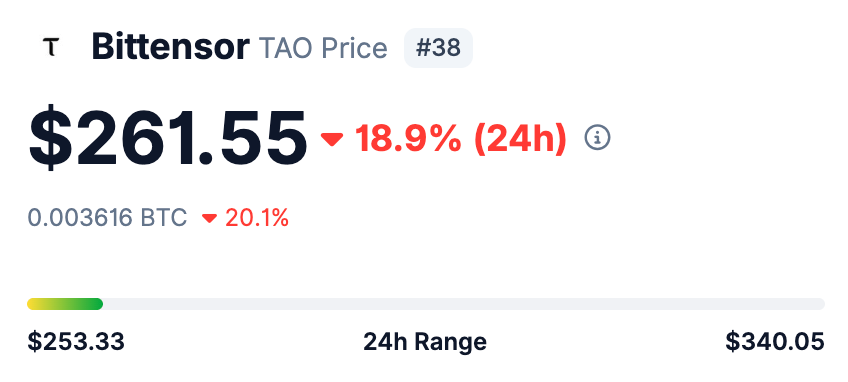
TAO dropped 15% within 24 hours of the announcement.
Decentralization is frequently the headline. How governance actually works in practice is a different question, and one that directly affects token holders when things go sideways.
Top AI Crypto Tokens in 2026: Curated List
Bittensor ($TAO)
Despite the recent situation with Covent AI leaving the network, Bittensor is still the largest AI token by market cap. The drama is fresh, but not fatal.
Overview: Bittensor runs a decentralized marketplace where machine learning models compete to provide AI services. Nodes contribute compute and model outputs; the network scores their performance and pays in TAO.
What's live:
128 active subnets, each focused on a specific AI task like image generation, language models, financial intelligence.
A halving in December 2025 cut daily token emissions from 7,200 to 3,600 TAO.
Grayscale has filed with the SEC for the first US-listed Bittensor ETP, signaling growing institutional interest in regulated exposure to the token.
Key risk: Governance. It still matters. In practice, it doesn't match the decentralization on paper and that's what the Covenant AI exit made visible.
One team's departure moved the price 15%. It may be a brief hiccup, but it’s also a signal about how much weight individual actors still carry in this network.
Render connects people who need GPU compute with operators who have idle hardware.
You pay in RENDER, the node operator earns in RENDER. Simple barter deal.
What's live:
Migrated to Solana for lower transaction costs.
Verified use in commercial media production.
A governance proposal to integrate 60,000 GPUs from Salad Network went to vote in April 2026 and that’s a potential for major capacity expansion.
Key risk: The AI training use case requires a consistent supply of high-end enterprise GPUs that centralized cloud providers currently dominate. Competition from Akash Network (AKT) on the decentralized side is also real.
Best suited for: Those who want exposure to decentralized compute with a product already used in production environments.
ICP is designed to host web applications, enterprise systems, and AI models directly on-chain, bypassing traditional cloud infrastructure entirely.
What's live:
High developer activity (200+ daily commits per Santiment data).
Active government cloud partnership discussions.
A tokenomics upgrade proposal, "Mission 70", would burn 20% of network revenue to create deflationary pressure tied to cloud usage.
Key risk: Mission 70 is still a proposal, not a live mechanism. ICP has also historically struggled to hold value relative to its launch price, making sentiment fragile.
Best suited for: Those interested in the "decentralized cloud" thesis over a longer time horizon.
Co-founder Illia Polosukhin, an AI/ML researcher who previously worked on TensorFlow at Google, has stated that AI agents will become the primary users of blockchain.
Key risk: The gap between benchmark TPS figures (tested in controlled conditions) and actual daily organic usage. High throughput on paper doesn't always translate to fee-generating economic activity.
Best suited for: Investors who want Layer-1 exposure with a credible AI agent angle and an established developer ecosystem.
Grass aggregates unused residential internet bandwidth to scrape and certify data for AI model training.
Users earn rewards simply by keeping GRASS browser extension or Android app active.
What's live:
Over 18,000 agents deployed across the network, with approximately one million completed tasks and over $1.16 million in cumulative agent revenue recorded.
Built as a Layer-2 on Solana.
Key risk: Token supply dynamics. A scheduled vesting event in late February 2026 unlocked 55 million GRASS tokens, introducing significant short-term sell pressure. More unlocks are in the schedule.
Best suited for: Those interested in the DePIN (Decentralized Physical Infrastructure) category and comfortable with higher supply-side volatility.
FET is the unified token of a merger between Fetch AI, SingularityNET, and Ocean Protocol and CUDOS, four projects covering autonomous agents, AI model marketplaces, and decentralized data.
What's live:
All four underlying networks are operational
The alliance covers the broadest range of AI-related functions of any single token on this list: agents, data, and model access
Key risk: The merger narrative is stronger than the integration reality. Three distinct codebases and communities don't automatically become one coherent product. Execution across all three fronts simultaneously is a genuine challenge.
Best suited for: Those who believe in AGI and want broad AI sector exposure through a single, higher-liquidity asset.
Virtuals provides the infrastructure for deploying tokenized AI agents on-chain.
Anyone can launch an agent, set its revenue model, and let it transact autonomously. The protocol takes a fee; token holders benefit from the activity.
What's live:
Over 18,000 agents deployed, $470 million in cumulative Agentic GDP, and approximately $1.16 million in cumulative agent revenue.
Agent Commerce Protocol (ACP) launched in late February 2026, enabling agent-to-agent transactions.
Key risk: Protocol revenue peaked at $3.9 million per month in January 2025 before declining sharply. Such a pattern is typical of AI agent hype cycles. The token also sits significantly below its all-time high.
Best suited for: Higher risk tolerance. This is the most speculative category on this list, because the upside is real, but so is the downside.
Most major AI tokens live across several different blockchains.
RENDER is on Solana. GRASS is a Solana Layer-2. VIRTUAL runs on Base. NEAR has its own chain. Buying them from a single centralized exchange often means navigating multiple withdrawals, bridging assets manually, and paying fees twice.
The faster path is a swap platform that handles cross-chain routing without making you do the legwork.
Supported chains on ChangeNOW
ChangeNOW supports swaps across: Ethereum, Solana, BNB Chain, Base, Arbitrum One, Polygon, Avalanche C-Chain, TON, Tron, Aptos, Sui, Optimism, and more.
Where it gets even more useful
Most platforms support USDT on Ethereum, BSC, or Tron.
ChangeNOW extends USDT pairs to less common but actively used networks, including Tezos, KuCoin Token (KCS), KAVA EVM, Celo, NEAR, and Aptos.
That matters when you're holding USDT on one of these chains and want to move directly into an AI token without routing through Ethereum first and absorbing the gas costs.
If your USDT is sitting on TON or Aptos, you can swap it into an AI token directly with no bridging.
How to swap an AI token on ChangeNOW
Choose a token and the amount
Choose the AI token you want
Fill in the payout address
Confirm
The platform handles routing automatically. You don't need to know which chain a token lives on to execute the swap.
RENDER connects people who need GPU computing power for 3D rendering, AI inference, or model training with node operators who have idle hardware. You pay in RENDER, the operator earns in RENDER. It's essentially a decentralized marketplace for compute.
ICP has historically been volatile since its 2021 launch, when it debuted at a very high valuation and corrected sharply.
More recently, price movements tend to track broader crypto sentiment and AI sector cycles. A proposed tokenomics upgrade, "Mission 70", that would introduce a deflationary burn mechanism is still pending governance approval, and uncertainty around it has kept sentiment cautious.
NEAR is a Layer-1 blockchain originally built for general-purpose smart contracts, now positioning itself around AI agent infrastructure. Its native token is used for transaction fees, staking, and governance.
The network is known for fast finality and a sharded architecture designed to handle high transaction volumes.
No, GRASS doesn't use mining.
Instead, users contribute unused internet bandwidth by running a node. The network uses that bandwidth to source and verify data for AI model training, and rewards contributors in GRASS tokens. It's part of the DePIN category, not proof-of-work.
You can buy, sell or swap FET easily on ChangeNOW. For swaps, all you need is some crypto and a wallet address. You don’t even need to create an account.
AI tokens are cryptocurrencies tied to blockchain projects building infrastructure for artificial intelligence. Things like decentralized compute, data sourcing, privacy layers, and autonomous agent networks.
The token is typically what you use to pay for services, earn rewards, or participate in governance within that network. For a full breakdown, see the first section of this guide.
Most crypto projects added an AI narrative after the market decided AI was the next big thing. NEAR Protocol had founders with machine learning backgrounds years before that trend existed.
TON vs GRAM vs Toncoin: Same, But Different, But Same?
Toncoin is becoming GRAM. And no, you don't need to do anything. Here's what's actually changing, what isn't, and how ChangeNOW is handling the transition.
An objective, data-driven Cardano price prediction for 2026–2030. We analyze ADA's developer activity, DeFi metrics, and upcoming network upgrades to map out realistic market scenarios.