




Ever thought about why altcoins can bleed while Bitcoin barely moves? Or why traders start talking about BTC dominance every time the market gets nervous?

Ever thought about why altcoins can bleed while Bitcoin barely moves? Or why traders start talking about BTC dominance every time the market gets nervous?
BTC dominance shows Bitcoin’s share of the total crypto market cap. If BTC dominance is 55%, Bitcoin makes up 55% of the market value tracked across crypto assets.
The number looks straightforward until capital starts rotating across the market.
Periodically, Bitcoin leads the market higher. In other phases, altcoins collapse faster and push BTC.D up during weak BTC price action.
The same rotation works in reverse during altcoin season: traders move deeper into ETH, large-cap alts, and higher-risk sectors, and BTC dominance starts losing ground.
Traders still watch the chart in 2026 because these rotations keep coming back.
The metric comes in handy once it stops looking like a simple “Bitcoin vs altcoins” score.
Disclaimer: BTC dominance tracks market share, not guaranteed future price direction. The chart makes more sense next to liquidity, stablecoin flows, exchange volume, and market structure.
The percentage moves when Bitcoin, ETH, stablecoins, or altcoins shift the market cap balance.
CoinMarketCap tracks Bitcoin dominance as Bitcoin’s share of the total crypto market capitalization.
When Bitcoin grows faster than the rest of the market, BTC.D rises. When capital rotates into ETH, altcoins, or stablecoins faster than into Bitcoin, the percentage usually falls.
In 2026, traders usually read BTC dominance next to:
One chart rarely explains the full setup.
Gemini defines Bitcoin dominance as:
Bitcoin’s share of the overall crypto market.
The formula looks simple:
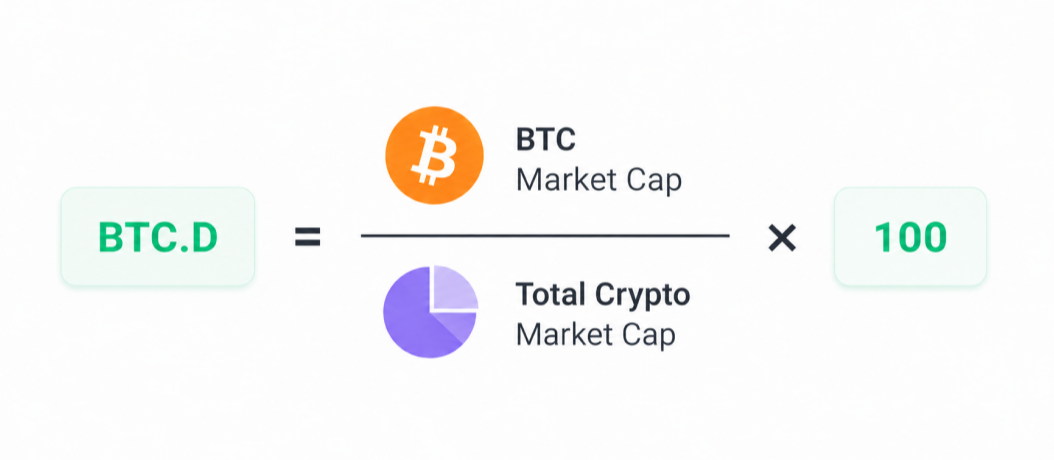
Bitcoin market cap comes from BTC price multiplied by circulating supply.
The denominator includes Bitcoin, ETH, stablecoins, meme coins, AI tokens, infra coins, and thousands of smaller assets.
Putting it bluntly, the denominator matters more than many beginners expect.
A large stablecoin mint can move BTC dominance. A wave of low-float meme coins can move it too. Market cap growth does not always mean fresh liquidity entered the market.
Many traders avoid reading the metric alone for this reason.
The video above gives a simple visual explanation of how Bitcoin dominance works and why capital often moves between Bitcoin and altcoins in cycles.
TradingView’s BTC.D chart tracks how market share moves between Bitcoin and the rest of crypto.
Bitcoin can rally while BTC dominance falls if altcoins are running even faster.
The opposite can happen too. Bitcoin can drop while BTC dominance rises because altcoins are taking a harder hit.
Bitcoin’s role as the market liquidity anchor is one reason many traders still debate whether BTC remains a good long-term investment during broader crypto rotations.
Many traders compare the move against:
The cleanest read comes when several signals point in the same direction.
BTC dominance moves when the market cap balance shifts between Bitcoin and the rest of crypto.
Common triggers include:
The setup gets easier to read when these factors line up with BTC price, ETH/BTC, funding, sector breadth, and spot volume.
During defensive market phases, traders often rotate back toward Bitcoin while miners continue securing the network regardless of short-term altcoin volatility. Local regulation still matters though, especially for large-scale operations and power access. Bitcoin mining laws and restrictions can still affect regional market sentiment and infrastructure growth.
Many traders see dominance falling and call altcoin season too early.
The link is real, but the signal is incomplete.
A few large meme rallies can drag BTC dominance lower without lifting the broader altcoin market. Thin liquidity can inflate market caps fast during speculative rotations.
Stronger altcoin cycles usually spread across several areas:
The market rarely flips from “Bitcoin only” to “everything pumps” overnight. Anyone who has traded an alt cycle knows the fakeouts can be brutal.
Next read: What Is Altcoin Season?
BTC dominance tracks relative market share and doesn’t confirm direct trade entries.
Bitcoin can rise while BTC.D falls. Bitcoin can fall while BTC.D rises. Traders who ignore price structure, liquidity, and volume can misread the setup fast.
Stablecoin growth changes the denominator behind BTC dominance.
Large USDT or USDC inflows can push BTC.D lower without broad altcoin participation.
A few viral charts do not make a healthy altcoin market.
Broad participation typically matters more than isolated pumps.
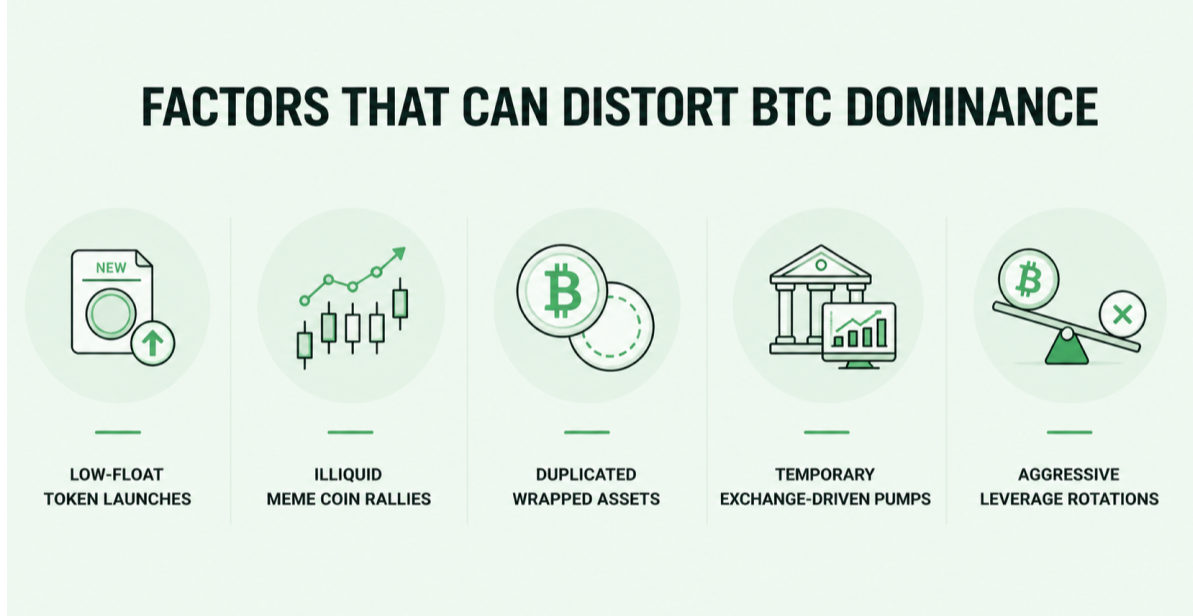
The percentage can move for reasons that have little to do with real Bitcoin demand.
A thin meme coin pump, a noisy listing, or a leverage wipe can move the percentage before traders can actually exit size.
So the chart needs a second look: who is buying, where the volume sits, and whether the order books can handle real trades.
BTC dominance works better as market context than as a standalone signal.
Many traders use the metric to see where attention and liquidity are clustering.
| Signal | Typical Market Read |
|---|---|
| BTC price + BTC.D rising | Bitcoin controls flows |
| BTC price rising + BTC.D falling | Altcoins running faster |
| BTC price falling + BTC.D rising | Altcoins getting hit harder |
| BTC.D falling + stablecoin dominance rising | Risk stays defensive |
The chart gets more useful next to:
No single metric explains the entire market.
The metric remains relevant in 2026 because it shows where capital is actually crowding: Bitcoin, stablecoins, or higher-risk alts.
BTC.D gets interesting when the chart lines up with BTC price, ETH/BTC, funding, liquidity, and sector strength; without that context, one percentage can make a weak setup look stronger than it is.

What Is CC Coin and How It Works
This article explains what CC Coin is, how it works, and why it matters. Learn how the token is used, what drives demand, and how to get CC.

Bitcoin Halving 2024 Explained: What It Means for BTC and Altcoins
Learn everything about Bitcoin Halving 2024: its impact on BTC price, historical trends, and altcoin reactions | Stay prepared for the next big move in crypto