Welcome to the ChangeNOW Blog. Here we focus on research, real use cases, and practical insights — not hype. While we double-check our facts, nothing here should be taken as financial advice; crypto is a high-risk space, and your own research always matters.
Swapping tokens used to be a simple activity. All you needed was your wallet, then you select a DEX to use from a small selection, and you could execute your trade within minutes.
However, relying on this simple 'pick one DEX and swap' approach in 2026 is a gamble that could lead you to losses or failed trades. This is due to the explosion of DeFi activities, which has led to a growing number of DEXs across dozens of chains. As a result, liquidity is fragmented across multiple platforms, making it challenging for traders to manually compare prices and gas fees for every trade. Fortunately, DEX aggregators were built to solve this problem.
Instead of you moving from one DEX to another in search of better prices and fees, a DEX aggregator does that for you. It scans the entire decentralized market to find you the best trading path that you could get on a single DEX. And if you are a business with an aggregator API, you could offer token swaps without having to build direct liquidity connections with every DEX. Think of these solutions as the search engine for DeFi trading.
For this reason, this article has analyzed some of the best DEX aggregators you could use in your trading based on their swap fees, supported networks, assets, and how reliable they are.
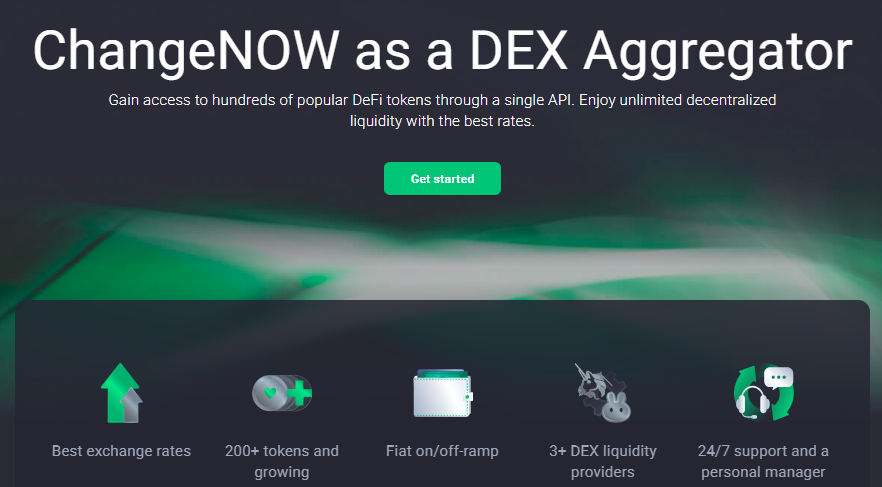
After analyzing all the solutions, we have concluded that ChangeNOW is the best DEX aggregator. Integrating it, you can get the best rates, use a non-custodial exchange, or integrate a powerful aggregator into your own product. Integration is easy through a single API, and it comes with high liquidity aggregated from the world's largest DEXs, customizable commission, 24/7 support through a personal manager, over 200 DEX tokens, cross-chain swaps, and more.
The List of Best DEX Aggregators
Below is a breakdown of the best DEX aggregators in 2026:
ChangeNOW
1inch
Velora (formerly ParaSwap)
Rubic
Matcha
How We Select the Best DEX Aggregators: Evaluation Criteria
When we evaluate DEX aggregators, the focus is on three key factors: swap fees, supported assets and networks, and reliability. These factors show the efficiency of a solution at facilitating DeFi trading.
Swap Fees: A DEX aggregator should be affordable to trade on. No one wants to lose money on high fees. Here, we evaluate the total costs incurred when exchanging tokens. The best DEX aggregators should help you trade with low or no added platform fees and have techniques to help reduce blockchain network fees (gas fees). We also look at how clear fee structures are and if there are any hidden costs.
Assets & Networks: The best DEX aggregators should support many cryptocurrencies and blockchains. This flexibility saves you from hopping between solutions. It also means connection to liquidity access because of many networks.
Therefore, we evaluate whether a DEX aggregator is built for a single chain or multiple chains and whether it supports cross-chain swaps.
Reliability: Here, we evaluate the consistency and accuracy of a DEX aggregator from the moment you see a quote to the moment the tokens land in your wallet. All the above aggregators search across liquidity sources. But the price you see on the screen (quote) is only part of the story. The price you get (execution) depends on gas cost, slippage, and protection from 'predators' who try to profit from your transaction, a scenario commonly referred to as MEV (Maximal Extractable Value).
We also evaluate the speed of the DEX aggregators to execute trades and the API uptime for developers integrating a DEX aggregator with their businesses.
Each DEX aggregator differs across the above checklist. The table below provides a direct comparison for easier evaluation:
Aggregator
Swap Fees
Assets and Networks
Reliability
ChangeNOW
Dynamic fee structure included in the exchange rate, partner fees customizable starting from 0.4%
200+ DEX tokens, cross-chain swaps across 150+ blockchains
Average swap time under 2 minutes, API reliability of 99.99%, and 350 ms response time, automatic fallback execution paths
1inch
Mode-based (classic mode requires network gas fees, while Fusion swaps are usually gasless)
Supports tokens with liquidity on supported DEXs, available across 13+ chains (12 EVM and Solana)
Swap speed depends on the mode used (Fusion swaps average around 14 seconds), MEV protection
Velora (formerly ParaSwap)
Mode-based (market mode may have 0.15% interface fee, while the Delta mode uses surplus-sharing)
144+ crypto token pairs, cross-chain swaps across 12 chains
Swap speed is mode-based (market mode speed depends on the network, while Delta mode executes in 10–15 seconds), MEV protection
Rubic
Zero protocol fees for swaps under $100 and most stablecoin/native token swaps, private mode may include additional fee uplift
70,000+ tokens across 70+ chains, cross-chain swap support
Swaps complete within 2–10 minutes (private swaps may take longer), MEV protection
Matcha
Regular swap fees range from 0%–0.1% depending on network, Matcha Auto fee of 0.25% (0.05% for stablecoin-to-stablecoin trades)
Supports 15 chains and cross-chain swaps for selected tokens and chains
Most trades settle within 30 seconds to a few minutes, MEV protection
ChangeNOW
Overview:ChangeNOW serves as a DEX aggregator by connecting to multiple DeFi liquidity sources. For regular users, this means you can swap crypto without manually checking rates across different DEXs.
If you are a business, ChangeNOW offers an aggregator API that allows you to add token swaps without building direct liquidity connections with every DEX. The integration process is designed to be flexible and easy to implement, supported by a personal manager available 24/7. Once integrated, your users enjoy the best exchange rates from 3+ DEX liquidity providers, non-custodial swaps, fiat on/off ramps, fixed-rate and standard flows, and many more benefits.
Swap fees: ChangeNOW charges a dynamic fee for transactions that vary depending on the currency and the exchange amount. This fee is included in the exchange rate. However, it is important to note that the fee structure is transparent with no hidden fees, ensuring you get the best rate for your crypto swaps. Network fees and all other exchange charges are included in the rate.
Also, as a partner integrating the DEX aggregator to your business, you get the ability to customize the fee starting from 0.4% and have the flexibility to adjust it up or down according to your preference.
Assets & Networks: ChangeNOW DEX aggregator supports 200+ DEX tokens. In terms of networks, the platform is multi-chain with support for cross-chain swaps across 150+ blockchains, including leading giants like Bitcoin, Ethereum, Solana, BNB Chain, and Polygon.
Reliability: ChangeNOW swaps typically complete in seconds or minutes, with the average time being under 5 minutes, depending on the network.
In addition, the API integration comes with a 99.99% reliability and 350 ms response time, which means it can return updated exchange rates for pairs in just over one-third of a second. This means your users enjoy faster swaps and are able to lock in rates quickly before they change.
When it comes to user protection, the system proactively detects common errors, such as incorrect networks or missing memos, to prevent fund loss. If a specific liquidity source fails, fallback execution paths are triggered automatically to keep the transaction moving.
Overview: 1inch is one of the oldest and most established DEX aggregators. As a pioneer in this space, the platform offers two main swap modes: Classic and Fusion.
The classic swap mode is the traditional aggregation mode that routes trades across multiple DEXs using the Pathfinder algorithm to find the most efficient paths for a token swap. This model also supports split routing, where a single large trade can be divided across multiple DEXs in the shortest time possible to reduce slippage and access better pricing. When using this mode, users pay the gas fees.
Fusion mode, also known as the intent-based swap, on the other hand, offers users a way to execute swaps without spending gas or risking being front-run by bots (MEV). This is achieved through the use of third-party professional market makers (resolvers) who compete to fill the orders.
In addition, 1inch supports limit orders, which allow users to specify the exact price at which their trade should be executed, and 1inch Terminal (formerly Pro), meant for professional traders.
Swap fees: 1inch has different types of fees that depend on the trading mode you choose. As we have seen, in the classic swap mode, you pay the network gas fees directly to the blockchain to process transactions. These fees require you to have a balance of the network-native token, and they vary due to the token pair or network used. The important thing is that estimated gas fees are always shown before confirming.
In the intent-based and atomic cross-chain swaps, you usually do not pay gas fees; they are covered by the resolvers who fill your order.
Assets & Networks: The DEX aggregator allows swapping any token that has liquidity available on supported DEXs across 13+ chains, among them 12 EVM chains and Solana. The platform also introduced Fusion+ technology in 2024, which enhances cross-chain swaps using intent-based architecture and atomic swap mechanisms.
Reliability: Swaps on 1inch are usually fast, but the speed of execution depends on the mode used, network, and gas settings. In the classic mode, transactions with higher gas fees are confirmed faster, while lower-fee transactions may wait longer, especially during network congestion.
In Fusion mode, swaps are a bit faster, with a median execution time of around 14 seconds, with 25% of swaps settling in under 9 seconds. Cross-chain swaps, on the other hand, may take a bit longer depending on the chains involved.
In terms of security, 1inch offers MEV protection through intent-based execution, which enables users to specify the outcome they want from a trade. Cross-chain swaps are also protected by this design.
Velora (formerly ParaSwap)
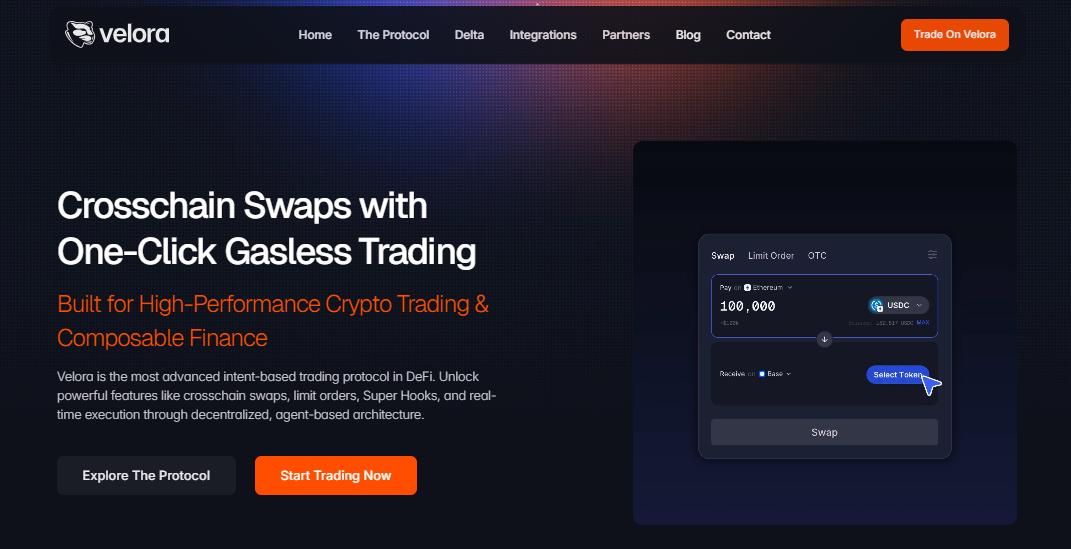
Overview: Velora is a decentralized trading protocol that aggregates liquidity across multiple blockchains and DEXs. Its current execution architecture has two modes: Market and Delta.
Market mode is the normal aggregation approach where smart contracts (specifically the Augustus Swapper) analyze the market in real-time to get the best rate possible. This approach also supports trade splitting, where if a direct trade is inefficient, it distributes the order to different DEXs. For example, it might route 40% of the trade through Uniswap, 30% through Curve, and 30% through a private market maker.
Delta, on the other hand, is an intent-based model launched in 2024 that lets users define the goal (the intent) rather than the path. For example: 'I want to end up with 2,500 USDC for this 1 ETH.'
This is achieved through the use of Agent-Based Architecture, where a network of agents known as solvers compete to fulfill your intent. Because these solvers compete against each other to give you the best deal, you receive the most efficient execution possible. They, in return, earn the spread between your signed minimum and the actual execution.
The aggregator also supports limit orders. You can use it directly through the website or integrate it into your decentralized applications (dApps) through the Velora API.
Swap fees: In Velora, fees depend on the execution mode used. When using the market mode, users primarily pay underlying DEX trading fees and blockchain gas costs, although the Velora UI may apply a flat 0.15% interface fee on certain swaps.
In the Delta mode, execution relies more on surplus-sharing rather than a fixed trading fee, where the protocol can capture part of the positive slippage generated when execution exceeds the user’s minimum expected output. If the swap fills at exactly the quoted price, the protocol earns nothing.
Assets & Networks: The aggregator offers 144 different pairs of crypto tokens with support for cross-chain swaps across Ethereum, Binance Smart Chain, Avalanche, Polygon, Gnosis, Arbitrum, Optimism, Base, Sonic, and Unichain.
Reliability: Speed on Velora is based on the settlement method you choose. In the market mode, the speed is entirely dependent on the network you are using. The Delta mode, on the other hand, offers high-performance swaps with an average execution speed of 10–15 seconds.
Also, through the delta model, Velora protects against MEV attacks, such as front-running, because the solvers take on the technical risk of execution.
Rubic
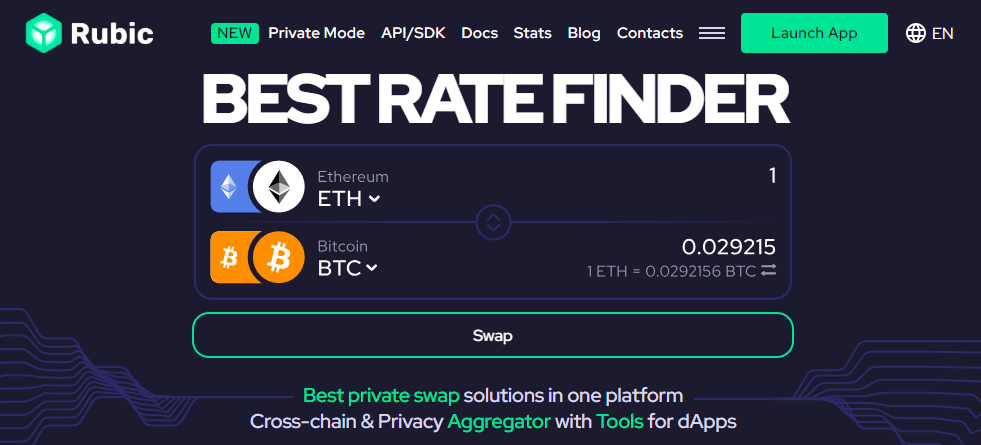
Overview: Rubic is a decentralized instant crypto exchange that aggregates 340+ DEXs and cross-chain bridges. As a DEX aggregator, it pulls rates from more than 10 different providers for popular chains using the 'Rubic’s Best Rate Finder' to find you the optimal transaction route.
One unique feature of the platform is the 'Private mode', which is currently in beta. This mode lets you swap tokens without publicly linking your wallet, balances, or trading strategy to the transaction. You get the same best rate execution Rubic is known for, but with optional, compliant privacy when you need it.
The platform also offers an API that allows you to integrate its functionalities directly into your own dApp.
Swap fees: Rubic offers zero protocol fees for swaps under $100, most on-chain swaps involving stablecoins or native tokens, bridging $USDT from popular EVM chains to TRON, and all swaps with Solana.
For larger swaps or other trade types, fees depend on the specifics of your transaction, like the network in use and asset pair, with none hidden. Also, the privacy mode may have a fee uplift.
Assets & Networks: The DEX aggregator enables swaps of over 70,000 tokens across 70+ chains with high support for cross-chain swaps. The Private Mode extends this flexibility by supporting privacy-first networks like Monero, ZCash, and Dash.
Reliability: Transactions on Rubic are mostly completed within 2–10 minutes, depending on the chosen networks and provider. However, private swaps may take slightly longer depending on the privacy route selected.
The platform also offers MEV-bot protection using the bloXroute, which connects you directly with validator nodes to securely hand off your transactions to protect you from front-running.
Matcha
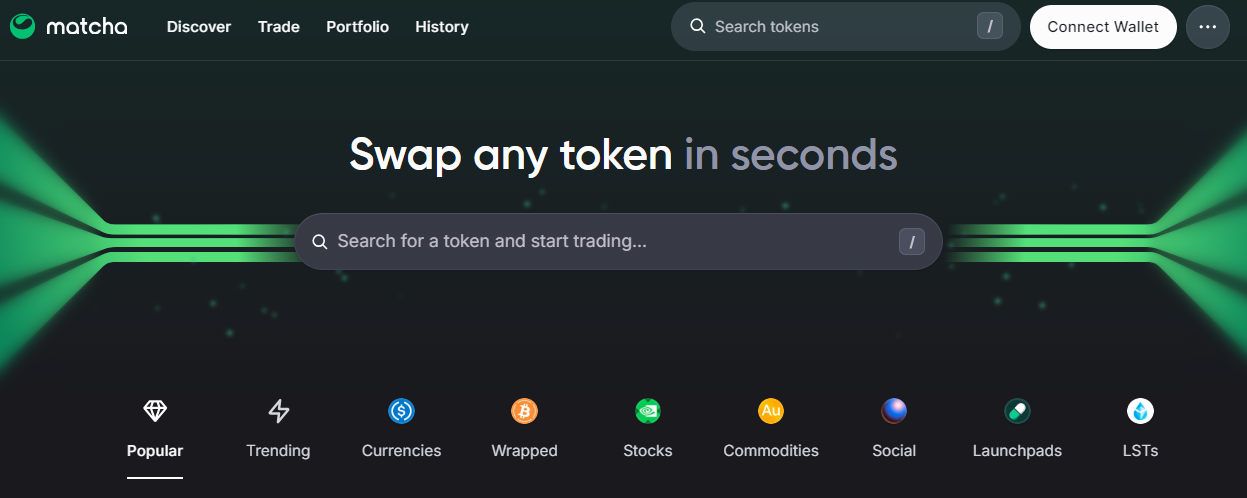
Overview: Built by the Ox team, Matcha is a crypto trading platform that also acts as a DEX aggregator by pulling pricing data from 100+ liquidity sources at the time of your trade to maximize the value you receive. The platform uses an automated process called ‘smart order routing’ to split your trade across all or several liquidity sources to provide you with the best price possible. This technique is especially helpful for larger trades where a single source is unlikely to offer you the best pricing.
Alongside this, Matcha leverages other order types, including RFQ (Request for Quotation) and order flow auctions settled by private market makers, which protect from MEV and achieve lower slippage. The platform also supports limit orders that let you set the price you want your trade to execute.
Swap fees: Like many other DEX aggregators, Matcha does not impose platform fees for swaps. The only fees charged are those for regular swaps, which vary by network, ranging from 0% to 0.1%.
However, the platform has a feature known as 'Matcha Auto' that has a fee of 0.25% (or 0.05% for stablecoin-to-stablecoin trades). The feature is meant to provide users with added value through gasless swaps, MEV protection, fast settlement, zero slippage, and more.
Assets & Networks: Matcha indexes millions of tokens across 15 chains, including Ethereum, Solana, Arbitrum, BNB Smart Chain, among others, and has support for cross-chain swaps. However, not all tokens and chains are supported on cross-chain swaps.
Reliability: All Matcha trades are sent to their respective blockchain for settlement. Therefore, the time it takes to complete a trade depends on how congested the network is and the amount of gas paid. But on average, most trades process within 30 seconds to a few minutes.
Also, users are protected from MEV and sandwich attacks through the RFQ settlement and the Matcha Auto mode.
Benefits for DeFi and Crypto Projects
By now, the benefits of DEX aggregators may be apparent from the platforms discussed above. However, it is important that we also summarize some of them, which include:
Access to Deep Liquidity: DEX aggregators provide DeFi projects with access to a larger pool of liquidity by connecting them to many sources instead of one.
Reduced slippage: Trades are automatically routed through exchanges that offer the tightest price difference, which helps avoid costly price jumps.
Lower transaction costs: Smart routing helps reduce the amount of gas (transaction costs) paid by finding the most efficient path for a trade.
Seamless Cross-Chain Swaps: The majority of DEX aggregators support cross-chain swaps, which means users do not have to manually jump from one chain to another. This helps them easily take advantage of emerging opportunities in other blockchain networks and act quickly in the face of price hikes and falls.
Simplified Integration and Reduced Development Costs: Through APIs offered by the majority of DEX aggregators, DeFi and crypto projects can easily integrate their functionalities into their platforms to offer their users better trading experiences.
Enhanced User Trust: By finding the most cost-effective trading path for users and protecting them from MEV and other attacks, these aggregators help DeFi projects build trust in their customers, which helps them attract more.
Conclusion
The choice of a DEX aggregator largely depends on your preferred chain, the features you prioritize, and the scale or complexity of your trades. However, one thing all the solutions above have clearly demonstrated is that the days of manually jumping from one DEX to another in search of better execution are over. In today's DeFi landscape, we route the smart way.
And whatever your trading or integration needs may be, there is a DEX aggregator designed for them. If you are looking to integrate a DEX aggregator into your business, ChangeNOW offers one of the most flexible and reliable solutions you could use. To get started, complete this form, and our team will respond to your request promptly.
Blockchain business ideas are increasingly shaped by infrastructure costs, monetization speed, and operational complexity rather than hype alone. This article shows the most viable models through development requirements, revenue structure, and the time needed to reach profitability.
This article compares the 12 best developer-friendly crypto APIs for Web3 products in 2026. It explains what each API helps teams build, from embedded swaps and RPC access to market data, NFT tools, payments, wallet connectivity, and decentralized storage.
Multichain fragmented liquidity and turned asset movement into a bottleneck, making bridges core execution infrastructure rather than a supporting layer. This piece analyzes leading protocols based on how they handle liquidity, fees, and speed under real cross-chain conditions.