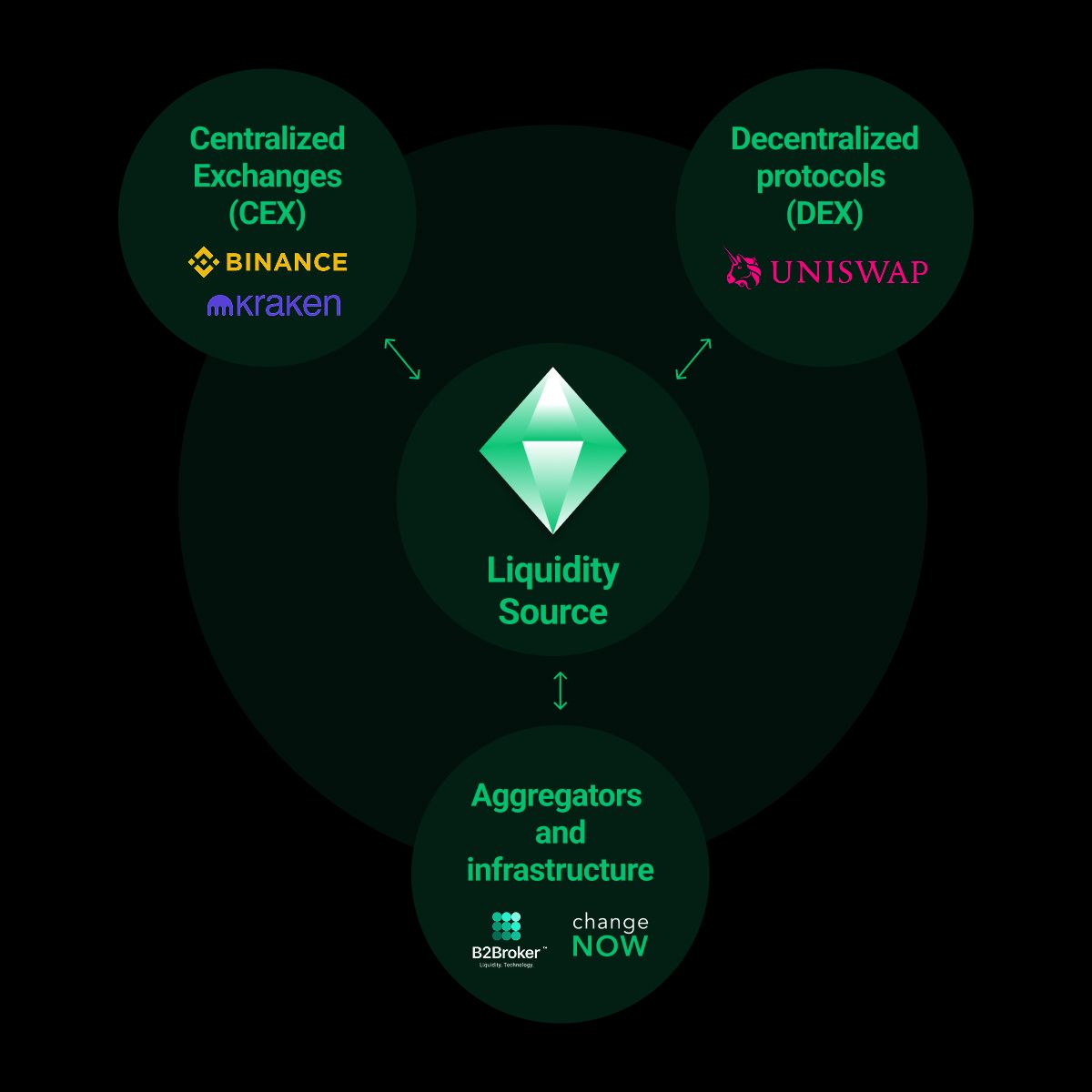
Predictable pricing and seamless swaps require deep liquidity, but fragmented markets often force crypto platforms to patch together multiple external providers to maintain execution quality. Centralized exchanges (like Binance or Kraken) deliver order-book depth and high trading volumes. Decentralized exchanges route swaps through automated market makers and on-chain asset pools.
ChangeNOW, the best crypto exchange liquidity provider according to our analysis, eliminates this overhead. Through a single API endpoint, it aggregates order-book volume and AMM reserves from more than 10 of the world’s largest exchanges. This integration has over 1,500 assets and 2 million trading pairs ready for deployment. While smart routing algorithms consistently lock in the best rates with minimal slippage, the platform's non-custodial design ensures your funds remain secure.
This article breaks down how liquidity aggregation works in practice, how integration models differ, and what defines a reliable execution layer.
Welcome to the ChangeNOW Blog. Here we focus on research, real use cases, and practical insights — not hype. While we double-check our facts, nothing here should be taken as financial advice; crypto is a high-risk space, and your own research always matters.
The list of best crypto exchange liquidity providers
ChangeNOW
B2Broker
Uniswap
Binance
Kraken
Our selection criteria
Depth of Liquidity:
Predictable pricing requires massive order books and aggregated routing. Deep liquidity keeps optimal rates, minimizes slippage, and drives up overall swap success rates.
Supported assets: Top-tier providers must have immediate access to major assets, emerging tokens, and diverse blockchains to keep their product highly competitive.
Commission model: Integration architecture, monthly trading volumes, and negotiated SLAs dictate the final pricing. Providers typically monetize through spread markups, flat fees, or revenue-sharing models; exceptions are really rare.
Compliance: Institutional integrations demand AML procedures, transaction monitoring, and operational security controls. Having a clear compliance framework helps partners reduce regulatory exposure.
Provider
Depth of Liquidity
Supported assets
Commission model
Compliance
ChangeNOW
10+ CEX/DEX (Binance, Uniswap, etc.)
1500+ coins; 110+ networks; Fiat (50+)
Rev-share from 0.4%; Fee included in rate
Non-custodial; KYC for risk/fiat; AML
B2BROKER
Institutional Prime-of-Prime
1500+ instruments (138 crypto pairs)
$10–$15 per $1M volume (high tiers)
Tier-1/2 regulated; AML/KYC; Bank license
Uniswap
User-funded AMM (v3 concentrated)
Any ERC-20 token (Ethereum, Polygon, etc.)
Fee tiers: 0.01%, 0.05%, 0.30%, 1.00%
Decentralized; No mandatory KYC; Open-source
Binance
Order book; >$20B daily volume
500+ crypto; 1500+ pairs
Maker-taker model; LP reward programs
Mandatory KYC; VASP registered; SAFU fund
Kraken
Order book; Kaiko score 83/100
500+ crypto; Spot & Margin
Pro model: 0–0.40% (maker-taker)
KYC; Proof-of-Reserves; Multi-jurisdiction
Fragmented liquidity across centralized order books and decentralized AMM pools complicates enterprise integrations. Infrastructure providers like ChangeNOW resolve this by aggregating volume from multiple sources into a single API connection.
The following analysis compares platforms commonly listed among the best crypto exchange liquidity providers, starting with ChangeNOW.
ChangeNOW
Overview: Launched in 2017, ChangeNOW is a noncustodial swap infrastructure that allows partners to integrate execution engines into wallets and fintech applications via APIs or widgets.
Depth of Liquidity: The system is an access point for capital from centralized exchanges and various decentralized environments, including DeFi pools. By pulling from 10 major venues like Binance, OKX, Uniswap, and KuCoin, the routing engine finds optimal rates at execution. Swap execution averages one minute. API transactions finish within five minutes
Supported assets: The platform covers over 1,500 coins, 2,250,000 exchange pairs, and 110 blockchains, along with fiat flows for 50 currencies. Accessing liquidity across centralized order books and DeFi pools guarantees broad market coverage.
Commission model: Integrations work on a revenue-share, where partners earn 0.4% per transaction. Pricing embeds the fee directly into the quoted exchange rate. A Fast-Track program provides new wallets with immediate API access for monetization, backed by media placements, reaching 400k users.
Compliance: SumSub is the KYC provider for ChangeNOW, and Identity checks are automatic for fiat-to-crypto purchases and for anomalies detected by the risk system. The service enforces AML monitoring and transaction risk analysis without holding users' funds and helps users correct transaction errors.
Verdict: ChangeNOW aggregates order flow from centralized exchanges and DEX markets, and its routing engine selects the best rate for users at that moment. Non-custodial architecture and API integrations suit wallets, fintech apps, and crypto platforms needing embedded swaps.
Overview: B2BROKER is a Prime-of-Prime trading infrastructure that channels multiasset capacity through the B2CONNECT hub, linking institutional platforms directly with top-tier liquidity providers.
Depth of Liquidity: Market depth from banks and other capital sources is part of the architecture to pool order volume. Trading APIs supply live price feeds alongside order-book data from major liquidity providers. The entire setup is optimized for millisecond execution environments.
Supported assets: The service maintains over 1500 trading instruments across multiple asset classes: forex, crypto, equities, commodities, metals, indices, energy, ETFs, fixed income, and NDFs. Infrastructure enables multi-asset trading across markets.
Commission model: Pricing incorporates swaps, markups, and treasury income. Volume tier rates for brokers range from $10 to $15 per $1 million traded, with final fee structures finalized through individual service agreements.
Compliance: Operations adhere strictly to AML and CFT standards, requiring complete client identity verification. All system-connected liquidity providers must possess Tier 1 or Tier 2 regulatory licenses. Furthermore, B2BROKER PRIME Investment Bank Ltd has an active Labuan Financial Services Authority license.
Verdict: B2BROKER is a good source for capital reserves and is a big hub for liquidity providers, with high-volume multi-asset markets. The core infrastructure is an established brokerage environment that requires raw, aggregated order flow. The enterprise focus builds a financial barrier for agile fintech startups. Furthermore, the opaque and individually negotiated fee structures feel like outdated corporate sales tactics, severely frustrating modern product teams demanding predictable commercial models.
Uniswap
Overview: Uniswap is a decentralized exchange protocol with automated market-making reserves. The architecture has tradable volume directly from users depositing token pairs.
Depth of Liquidity: Capital supply depends on Total Value Locked and active fund concentration. The v3 architecture allows liquidity providers to define specific price ranges for their capital, thereby maximizing efficiency. Uniswap Labs data shows ETH/USD execution capacity in v3 setups surpassing major centralized platforms. Spot availability within the premier decentralized bitcoin liquidity pool (ETH/WBTC) reached 3 times Binance levels and 4.5 times Coinbase depth.
Supported assets:
The protocol inherently supports any ERC20 token, eliminating the need for listing approvals and fees. Operations span multiple active networks, including Ethereum, Polygon, Avalanche, and Base.
Commission model: Protocol smart contracts implement multiple fee tiers: 0.01%, 0.05%, 0.30%, and 1.00%. Liquidity providers capture a proportional share of these trading fees. A decentralized autonomous organization governs the ecosystem, and in 2025, this entity approved routing a specific portion of swap fees directly into the central treasury.
Compliance:
The Uniswap protocol is functioning without centralized broker licenses or mandatory KYC procedures for smart contract interactions. All operational code remains fully open source on GitHub.
Verdict: Uniswap is the engine for permissionless trade execution through user-funded reserves. Market efficiency and available depth ultimately depend on the active price concentration set by participating liquidity providers.
Binance
Overview: The giant here, Binance, is a centralized cryptocurrency exchange. Institutional desks and active liquidity providers supply continuous quotes to build execution potential across global markets.
Depth of Liquidity: The platform dominates market capacity, generating over $20 billion in daily spot volume and $217 billion across combined spot and derivatives. This massive volume translates into extreme order book density. Active reserves show $8 million within ±$100 of the BTC market price, capturing 32 percent of global capacity in that range. Microstructure measurements indicate $3.86 million within 10 basis points of the mid price, adjusting securely to $2.71 million even during lower activity periods. This density allows institutional liquidity providers to execute massive blocks with nearly no slippage.
Supported assets: The exchange infrastructure natively lists more than 500 cryptocurrencies alongside over 1,500 trading pairs.
Commission model: The commercial structure utilizes a maker-taker fee framework. Operating essentially as a crypto liquidity provider, Binance rewards participants for maintaining continuous active quotes. Rebate calculations for these market makers can reach 0.0025% of trading volume across eligible pairs.
Compliance: Binance access requires mandatory user identity verification. Operations enforce strict AML procedures while collecting data for individual user risk profiles. Global registrations include Virtual Asset Service Provider status in Argentina and multiple other jurisdictions. Furthermore, a Secure Asset Fund for Users allocates 10 percent of collected trading fees to cover potential security incidents.
Verdict: Massive order books fueled by dedicated liquidity providers secure unmatched centralized order flow. However, capacity remains highly concentrated in major pairs, leaving long tail assets critically exposed to execution gaps despite strict regulatory and operational controls.
Kraken
Overview: Another centralized crypto exchange in the list — Kraken. It secures deep order flow directly from institutions and professional trading firms across spot and stablecoin markets. The infrastructure has a pure programmatic connection through APIs to power high-frequency automated strategies.
Depth of Liquidity: Institutional desks act as active liquidity providers to consolidate massive volume within the core matching engine. Spreads remain exceptionally tight, reliably hitting 1 pip in highly liquid markets. Platforms requiring connection to a top crypto liquidity provider use these real-time APIs to tap into raw order-book capacity. External analytics assign the venue a Kaiko score of 83/100, mathematically confirming resilient execution across major trading pairs.
Supported assets: Kraken natively lists more than 500 cryptocurrencies. The platform has futures and margin trading with leverage up to 10x beyond standard spot markets. Integrated staking services for dominant networks like Ethereum are part of the architecture.
Commission model: Retail instant conversions suffer from a steep 1% trading fee plus variable spread. Conversely, Kraken Pro is a competitive venue with a volume-tiered maker-taker framework. Dedicated liquidity providers supplying passive volume enjoy maker fees ranging from a flat 0.00% up to 0.25% based on rolling 30 day trading volume. Standard taker fees span from 0.08% to 0.40%.
Compliance: Kraken has stringent global oversight from North American and European regulators across all operations. Trading enablement demands exhaustive KYC verification and corporate AML due diligence. Furthermore, Kraken Financial supplies qualified custody with strictly segregated client assets under US jurisdiction. This model has mandatory two-factor authentication, cold storage reserves and publicly verifiable Proof of Reserves audits in place.
Verdict: Kraken crypto exchange gives measurable market resilience and easy tech access. Custody controls make it a trusted liquidity provider for cautious enterprises with heavy legal exposure. The strict compliance layers do lead to longer B2B onboarding times than offshore competitors, and the 1% retail execution fee presents a significant hurdle for any fintech trying to scale consumer fiat gateways.
Conclusion
Without deep order books, price stability disappears, and transaction execution slows. When selecting a b2b partner for a crypto project, you must choose providers that combine asset coverage and a predictable settlement infrastructure. Plus, good execution speed.
ChangeNOW is the best crypto exchange liquidity provider for integrations that require routing across centralized exchanges and DeFi markets. The platform has capital reserves from more than ten sources, including Binance, OKX, and Uniswap, ready for immediate deployment.
If you are evaluating ways to improve execution quality, expand asset coverage, or reduce dependency on a single provider, review ChangeNOW’s swap infrastructure and integration options here.
Blockchain business ideas are increasingly shaped by infrastructure costs, monetization speed, and operational complexity rather than hype alone. This article shows the most viable models through development requirements, revenue structure, and the time needed to reach profitability.
This article compares the 12 best developer-friendly crypto APIs for Web3 products in 2026. It explains what each API helps teams build, from embedded swaps and RPC access to market data, NFT tools, payments, wallet connectivity, and decentralized storage.